Award named for former biology professor continues to promote excellence.
Prior to this year’s commencement, the Class of 2021 chose Associate Professor of Marketing Kashef Majid as the 23rd recipient of the Mary W. Pinschmidt Teaching Award. “It was totally unexpected, ” says Majid. “It’s an individual award, but I think there’s really so much more. Your work in the classroom is a reflection of so many other people. It really is a team effort—it’s not that I hold something magical.”
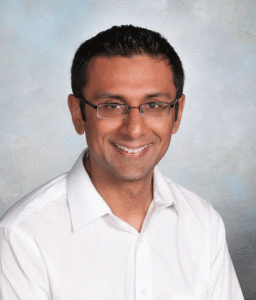
Majid might not hold a magical power, but his commitment to students during a pandemic year makes him stand out as a dedicated professor – just like Dr. Pinschmidt.
Named in memory of a beloved and longtime biology professor, the Mary W. Pinschmidt Teaching Award was established to annually recognize one faculty member selected by graduating seniors to have had the greatest impact on their lives. The late Mary Pinschmidt was one such exemplary professor.
Posthumously promoted to Distinguished Professor of Biology, Pinschmidt was committed to her students. She was heavily involved in Chi Beta Phi, pioneered several graduate and continuing education programs, and worked for many years on the HIV-AIDS Education Committee. In 1982, she became the eleventh recipient of the Grellet C. Simpson Award for Excellence in Undergraduate Teaching, the highest faculty award at Mary Washington.
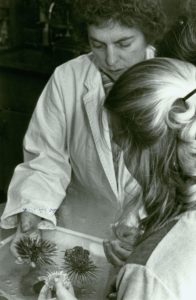
Pinschmidt also helped restructure Mary Washington’s general education program, including more core learning experiences for students of all levels. She even taught a class two days before her sudden illness and unexpected death in 1998. Perhaps most importantly, she left an enduring impact on the faculty and students who knew her.
Students quoted in the December 3, 1998, issue of The Bullet fondly remembered Pinschmidt as a “friendly, kind professor who was always there to help and never in a bad mood.” Her colleague at the time, Professor of Psychology Roy Smith, remembered her as “a wonderful presence in the classroom. She was an ultimate teacher. That’s who she was.”
Pinschmidt taught at Mary Washington for 37 years, often serving in high-level administrative roles. Her husband, Bill Pinschmidt, also taught biology at Mary Washington. Immediately following her death, those who knew her were determined to keep Mary Pinschmidt’s legacy alive by making gifts in her memory. Ultimately, those memorial gifts from caring family, friends, faculty, staff, and students helped create the teaching award that bears her name.
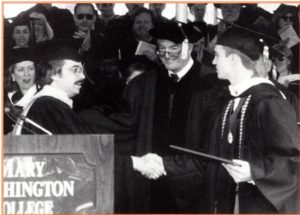
In 1999, Professor of Political Science and International Affairs Stephen Farnsworth was selected as the award’s first recipient.
“I’m one of the dwindling number of faculty members whose time at Mary Washington overlaps with Dr. Pinschmidt,” says Farnsworth. “I was honored to receive the award because she was an extraordinary faculty member, so committed to student excellence. It’s a wonderful tribute to her that this award exists. It’s great that it keeps her memory alive in a generation of students who now weren’t even born when she taught here.”
While today’s UMW students do not have the opportunity to learn from Pinschmidt, they continue to benefit from her legacy through lectures inside the Mary W. Pinschmidt Lecture Hall in Jepson Science Center and through the faculty who continue to share her commitment to student excellence.
For information about making a gift to support students and faculty, visit giving.umw.edu or contact the Office of Advancement at advance.umw.edu.
Article written by Advancement Intern Tabitha Robinson ’24