Originally shared with University supporters in October 2020
This year has brought about many changes for students, families, and institutions of higher learning. As the global pandemic continues, economic pressures and significant movements for social change have been at the forefront of the national dialogue and are in our hearts and on our minds here at Mary Washington.
Facing the Pandemic
Since March, our faculty and staff have demonstrated a true commitment to our students:
- With four days notice, faculty quickly moved from a face-to-face to an on-line environment. They adapted and pivoted to remote instruction to ensure our students completed their course requirements for the spring semester.
- Faculty also helped higher education across the world. Professor John Broome in our College of Education saw a need for faculty support and launched the “Higher Education Collective” on Facebook to connect them with basic and high-level remote-teaching tools. The result was a worldwide movement with more than 24,000 members in 100 plus countries that hopefully will continue to collaborate long after this pandemic has gone.
- More than 40 faculty members gave their time and talent to hold a multi-departmental COVID-19 IN CONTEXT COURSE, which was presented over several weeks in June and July. In total, more than 1,900 students, alumni, and friends from here in the U.S. and several countries enrolled in the free class. UMW students were able to earn three credits at no cost, which was welcome news for financially pressed families.
- Many of our loyal and hardworking staff worked to preserve and protect our historic and beautiful campus and look out for our students, each other, and our alumni. Two examples that show our commitment to community:
- Dean Cedric Rucker and others made random calls to check in on the well-being of students throughout the spring and summer.
- Alumni Relations led a Call-a-Mary-Washington-Friend program to do the same for many of our alumni across the country and around the world.
Once the full impact of the pandemic became apparent, we established the UMW COVID TASK FORCE (with more than 100 faculty and staff members). Their goal was to research, plan, and prepare a plan to return to campus. This was a monumental task in the face of poor odds and a continually evolving situation.
Led by Jeff McClurken, who also serves as Chief of Staff, Clerk of the Board, and Professor of American History, and Tim O’Donnell, Associate Provost for Academic Engagement and Success and Professor of Communication, the Task Force diligently and tirelessly coordinated with my Cabinet, administrators, faculty, and staff to develop protocols and processes to ensure a safe and successful return to campus. Among more than 100 submissions, UMW’s plan was one of only two approved without revision by SCHEV (State Council of Higher Education for Virginia) and was used as a model by several other institutions of higher education.
Implementing the Return to Campus
Following guidelines developed by the task force, our faculty spent countless hours planning for fall classes – working with the possibility of multiple modalities. We put our confidence and trust in our faculty, and they inspired us with their selfless efforts to be retrained and rework their classes.
- Courses were designed to be online, face-to-face, or a hybrid model.
- We made a strategic decision to delay fall move-in by three weeks and began all classes online. This decision was made to allow us more time to obtain testing supplies and to learn from the experiences of our peer institutions.
- During the week of September 10, nearly 1,700 students moved into the residence halls and classes resumed as originally planned for all 4,300 students. I am proud to say our students have been diligent and responsible as they work to protect themselves and each other. Their commitment to living as good citizens in this community have truly been outstanding, and I have received many words of praise from the local community for the students’ actions and behaviors.
- While many universities report a significant drop in enrollment, ours remains above forecast and stable.
- We had a surprisingly robust summer enrollment, with a 28 percent increase over the previous year. This steady enrollment demonstrates that our students believe in UMW and are responding to our commitment to ensure a safe and meaningful educational experience.
- The occupancy rate in our residence halls is 70 percent, which enables us to preserve 120 beds for possible quarantine and isolation.
- We continue to adapt and monitor, placing high priority on the safety and well-being of our students and employees.
Optimizing Financial Resources
One of the most critical challenges UMW faces is related to budgets. During fiscal year 20-21, we had to cut more than $10 million from operating budgets.
- Cuts were necessary due to refunds for meal plans and housing (from delaying our in-person start and truncating the semester), a decline in other revenue streams, and a reduction in expected funding from the Commonwealth of Virginia.
- We made every effort to preserve our programs and especially our people. As part of that, we instituted a hiring freeze and a tiered furlough system to ensure our most vulnerable employees are protected.
- As expected, one of the most significant increase in expenses has been the cost of personal protective equipment and testing supplies.
Certainly, there will be challenges in the months and years to come. Our response to this crisis has brought to light a much sharper focus on priorities and the resiliency of our people. The strength and character of this community has been showcased at its very best. It has been a transformative year for all of us at UMW.
Looking Forward
Despite the financial challenges facing UMW, I remain heartened by the continued support from our most loyal and dedicated donors like you. We feel your presence in our work daily, as your gifts work on your behalf in UMW’s mission. Your generous investment in Mary Washington has allowed us the flexibility to make decisions and pivot as needed to guide us through the uncertainty of the spring semester.
We are truly grateful for your support. The impact of your generosity is helping our students today and will continue to do so for generations. Although COVID-19 commands most of our energy and attention, you are also allowing us to prepare for life on the other side of the pandemic. I believe it is critical to continue with our investment in our future, including maintaining our stunning campus.
- We continue to advance on our capital projects with both state and private assistance.
- Seacobeck, the future home of the College of Education, is scheduled to be complete by November 2021.
- Renovated spaces like the Heslep Amphitheatre, Morris Stage, and Willard Hall have been ideal for socially distanced classes and other interactions.
- Renovation of Virginia Hall is continuing and it is projected to be open by the fall of 2021.
- The new Hillel Center built with funds from Larry Silver in memory of his parents is complete. It will be a wonderful resource for Jewish students.
- Depending on legislative priorities in Richmond, we hope to receive public support for a new theatre and the renovation of Melchers, duPont, and Pollard Halls. In their seventh decade, these buildings have been stretched beyond their capacity, and their appearance and functionality fall short of the Mary Washington standard. It is essential that we address these buildings before they become detrimental to students’ experiences. We welcome the help of our Washington Society members to encourage our state legislators to consider these capital projects among their funding priorities.
- All of these enhancements are critically important for providing the best learning environments and maintaining our reputation as a beautiful campus, both of which are critical for recruiting students.
- Alumni and friends are also excited about the projects as they seek to name spaces on campus. The gifts received for these purposes are going into the newly formed Campus Preservation Fund.
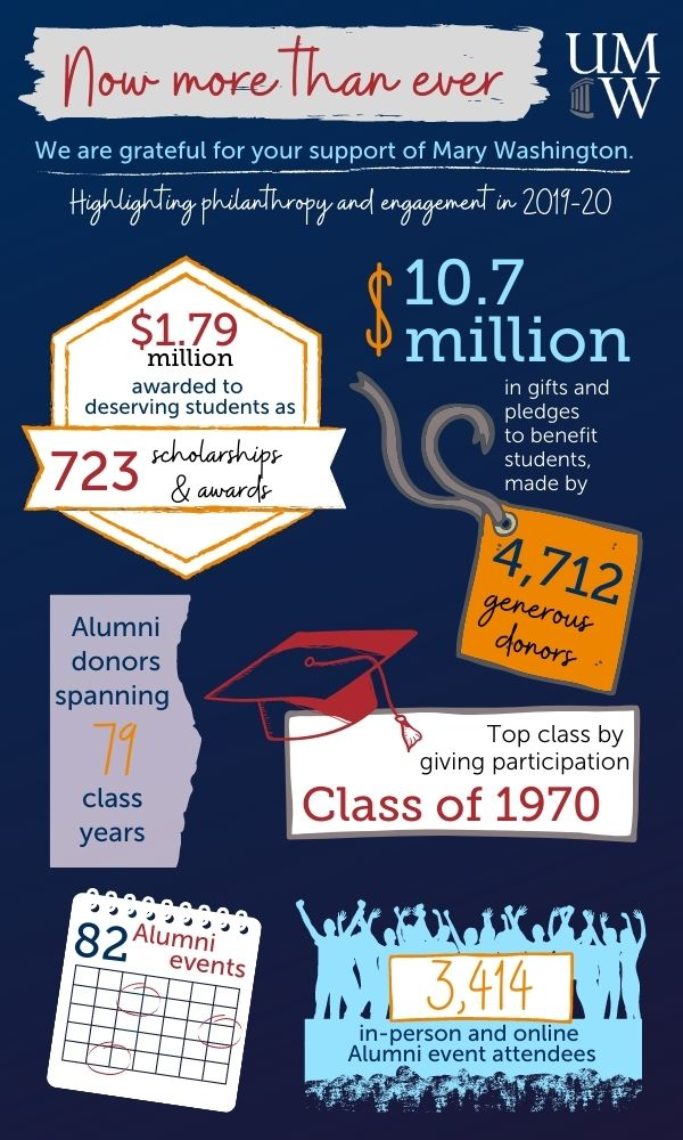
- This academic year, private support is funding 396 scholarships and student programs totaling close to $2 million.
- This includes eight active Washington Scholarships for in-state students and eight Alvey Scholarships for out-of-state students. We have documented estate pledges for another eight full-ride scholarships.
- Many privately funded scholarships support experiential learning to complement classroom theory. Study abroad and internship support is especially important in preparing students with a “portfolio” of experience as they pursue careers.
- Many donors support special funds identified specifically for students experiencing unpredictable life circumstances or for those who need emergency assistance. A surprisingly large number of students are experiencing food and housing insecurities.
- Despite the pandemic, a food and clothing closet are available for students to discretely select the things they need.
- Other donors have funded critical support services for students. In 2014, Betty Talley ’68 made a significant gift to endow and name the counseling center for UMW students. Mental health always is a significant concern, and of particular importance during this global pandemic.
The point that I want every Washington Society member to know is that you are key to every challenge met and success won. Whether it is with your advice, your experience, your connections, or your financial investment – you provide access, hope, and opportunity for all our students.
Celebrating Outcomes
The outcome of this unique Mary Washington education is a high-impact and transformative learning experience that lasts a lifetime.
- A great example is Allen Walter, a senior music major. He is 22 years old and says that before Mary Washington, he was the “ADHD kid who was always in trouble.” After high school, he initially didn’t think he even wanted to go to college. Given a second chance at UMW, Allen currently lives on his own and is paying for his education with help from one donor’s endowed scholarship. The scholarship compels him to “work ten times harder” he says, and he will return next year to finish a masters in education. As someone who has transformed from unfocused to highly motivated with a donor’s help, Allen wants to become a beacon of hope for other students.
- Thomas Bustamente is a senior biology major and has received several scholarships, including one that allowed him to travel to the Galapagos. He says when he first arrived at UMW, he saw the world as very black and white. With his undergraduate research experience in UMW’s Summer Science Institute and his study abroad program, his perception of the world has evolved. He says he now knows there are always exceptions, and he engages in deeper thinking to questions that seem simple like “What is a species?” He plans to pursue a graduate degree in freshwater ecology and conservation, and over time he hopes to become a professor.
These are only two stories, but I could tell you dozens as I hear students’ inspiring and often poignant stories of their Mary Washington journeys and how donors like you changed their lives.
Mary Washington is special to me because I see it as a place where we truly invest in students’ potential. Thank you for your generosity of spirit and your past gifts that are making a difference in providing transformative experiences for them! I ask for your continued partnership because you are essential to the future of Mary Washington and each of the lives it touches.
In this time of unprecedented change and unpredictable challenges, your support is a shield, a safety net, and, perhaps most importantly, a spark, illuminating a path forward. This past year, I believe we actually have become more attentive to our core values, our mission, and our goals. We have a clear sense of who we are, what we can overcome, and our distinctive value to our students, communities, the Commonwealth, and the nation. Thank you for your incredible commitment to being our partner and champion.
 Sharing good news about Mary Washington students and donors.