Giving Stories

UMW College of Education Hosts Virtual Visit with Award-Winning Educator and Author

Gloria Ladson-Billings Welcomes Students into Her Home

They read her book and learned about her life, teaching methods, and research. Recently, more than 65 UMW education students and faculty members enjoyed an up-close-and-personal virtual visit with Dr. Gloria Ladson-Billings.

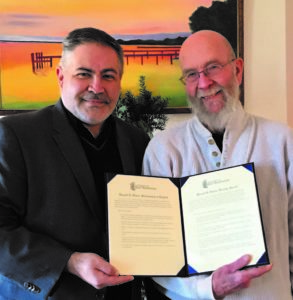
College of Education Professor John Broome says students in his Introduction to Teaching and Learning and Managing the Secondary Classroom courses had been reading The Dreamkeepers: Successful Teachers of African American Children. After one of the classes finished an online discussion from their individual spaces of social distancing, Ladson-Billings joined the virtual classroom from her home in Madison, Wisconsin.

“Gloria is literally one of the most famous, influential, and impactful education theorists and researchers in the world,” says Broome. “I wanted to do something special for my students, so I arranged a surprise to enable them to have some private time with her. She was happy to do it. I truly expected she would chat a few minutes, since she is always busy writing and editing books and articles, but she seemed to enjoy talking and answering their questions. At the end of the 90-minute virtual visit, my students were just shocked and smiling.”

Ladson-Billings spoke at Mary Washington in 2017 when she served as UMW’s Educator-in-Residence, and Broome has maintained contact with her since. During last week’s virtual visit, she responded to UMW student questions and offered real-world advice – from avoiding labeling young students with terms like “high risk,” to being fair and equitable in the application of classroom rules.

Virtual Classroom Visit

Overall, she advises future teachers, “Let your students know that you are human and have feelings, and then treat them as if they have feelings too. Remember, you are interacting with young human beings at one of the most critical points in their lives.”

She adds, “Teachers play a pivotal role, and it truly is important work. Don’t ever let anyone tell you it’s not!” Click here to read more about Gloria Ladson-Billings.

In addition to teaching education classes at UMW, Broome also has become a valued advisor to other educators as they adapt to teaching online during the worldwide COVID-19 pandemic. Recently, Broome was recognized for his leadership in launching the Higher Ed Learning Collective to share high- and low-tech remote-teaching tools for educators. The Collective currently has 25,000 members in 100 countries. Click here to read more about John Broome and the Higher Ed Learning Collective.

Celebrating and Teaching the Arts

While the month winds down and we’re all consumed with information about COVID-19, March gives us something to celebrate – Arts Education Month, and a teacher’s dedication to students.

Carole Garmon’s career – and art – is best described as one and the same.

Professor of Art Carole Garmon

Professor of Art Carole Garmon

The longtime UMW professor of art views the world through a visual lens, believing the creative process fuels the imagination. “We have to allow ourselves to imagine things beyond the tangible. Art is beautiful and sometimes challenging,” she said. “But it’s always a reflection on the self.”

A Texas native, Garmon was reflecting on her own future when she moved to Virginia to earn an MFA in sculpture at VCU. She came to work at Mary Washington in 1998, hired to update the sculpture area in Melchers Hall. Presented with a blank canvas, she was charged with creating – almost from scratch – a studio art program, which she says champions art as a career and a lifestyle, not “merely a lifelong appreciation.”

Her stance is the perfect portrait for March, Arts Education Month.

Garmon’s love of teaching is as extraordinary as her passion for artmaking. “Curiosity and wonder” are what drive her. Teaching allows her to constantly channel the creative process, even when she’s supposed to be sleeping.

“I’ll wake up in the middle of the night and brainstorm possible solutions for students,” she said.

Garmon is one of only two Americans chosen to participate in the international exhibition, Inspired By Rembrandt, commemorating the celebrated artist’s 400th birthday. Her work has been shown in D.C., San Antonio, New York, Peru and Berlin, with an upcoming exhibit in New Orleans.

She loves seeing former students’ art, too, around the world. She’s never surprised but always amazed.

“Some students say I act like they can do anything,” Garmon said. “What’s the alternative? Nothing?”

Q: What’s the most rewarding part of your job?
A: I work with talented students and faculty who recognize the importance of art and commit to a life that some view as “not as relevant” as traditional life goals.

Q: Most challenging?
A: Getting students comfortable with risk-taking, even failure. We learn a lot through these experiences; I’d say more so than from our successes. Think masterpiece, risk failure.

Q: How do you teach art virtually?
A: For many, it’s a first. My classes voted on how to proceed. We upload and comment on images through Canvas. My assignments provide openness, empowering students to push creativity while working away from the studio. They’re resilient and eager to keep learning. They’ve blown me away. A student who finally made it back to California just told me she had to bend her artwork to get it on the plane. We do what we have to do.

Q: Your favorite work of art?
A: Donatello’s sculpture of David. He’s far from the traditional heroic approach. When I saw him in an art history class, I couldn’t take my eyes off him. He blurs gender; the epitome of ambiguity. As photographer Sally Mann says, “If it doesn’t have ambiguity, why bother?”

Q: A mantra you live by?
A: “Never ask permission to take up space” and “If you’re asking the question, you already know the answer.”

Garmon asked to include a special addendum for this uncertain time:
“If you will stay close to nature, to its simplicity, to the small things hardly noticeable, those things can unexpectedly become great and immeasurable.” ― Rainer Maria Rilke, Letters to a Young Poet

Article written by Grace Winfield. First published in Eagle Eye 3/26/20.

2020 Giving Day Postponed

The University of Mary Washington has postponed its fourth annual day of online fundraising, Mary Wash Giving Day, originally set to take place Thursday, March 19.

In light of the unparalleled impact of the novel coronavirus (COVID-19) on UMW, the Fredericksburg community – and the nation, the University instead encourages its constituents to focus on each other, their loved ones, and their communities.

The generosity of UMW alumni, students, parents, faculty, staff and friends during past Giving Days has made a vast impact on the University’s mission and ability to serve students. The University will consider rescheduling Giving Day at a future point in time.


Professor Hamlet Inspired and Supported Students

Professor William N. Hamlet came to campus in 1911 for a job interview as one of the first members of the faculty at the new State Normal School in Fredericksburg. Later, he recalled that he did not actually plan to take the job, but, “when I looked upon this beautiful hill, I saw in perspective what glorious things might be accomplished.”

Professor Hamlet attended high school in Lynchburg, graduated from Virginia Military Institute with a degree in chemical engineering, and took courses at the University of Virginia and Cornell. He had several years of educational experience serving as assistant principal, principal, and head of the science department at high schools in Virginia and Arkansas.  At the time of his historic job interview, he held a position as the director of analytical chemistry in the medical department of what was then known as the Medical College.

Professor Hamlet accepted the teaching position at what is now the University of Mary Washington and taught science and math during those first few years.  As members of the faculty increased, he focused on math and educating future teachers to teach arithmetic to elementary and high school students. He continued to do so until his retirement 31 years later.

In the History of Mary Washington College, 1908-1972, Dean Edward Alvey Jr. said that Professor Hamlet was a conscientious and beloved teacher, but a quiet man. “Even with his long years of service to the college, he rarely ventured an opinion in faculty meetings, and he habitually walked about the campus with his head down. A student once remarked, with affectionate exaggeration, that the only way Mr. Hamlet knew his students was by their shoes.”

The students did appreciate Professor Hamlet’s gentle guidance and his love of dogs and nature. After his death in 1941, a tribute published in the summer edition of The Epaulet stated, “He saw life as an opportunity to serve others, to share what he possessed with others, and to teach his students the various facts and intricacies of mathematical procedures and how to apply them to their life activities. His philosophy of life was wholesome, inspirational, and sound. He was a philosopher, an adviser, and a loyal friend to all who knew him.”

An obituary published in The Bullet referenced the house on College Avenue that the Hamlets sold to the school in 1937. “Mr. Hamlet will not be forgotten by present students or by those who ever attend this college, because they had the privilege of knowing his fine character. He will be known to future students as part of the background and tradition of the college. His former home, which we will know as Hamlet House, will keep his name always alive on our campus.”

Through his estate plans, Professor Hamlet bequeathed to the college a farm in Spotsylvania County to be used as a recreational area and a bird sanctuary. This thoughtful gift made him one of the first members of the Heritage Society.