Painting a picture of the quantum realm has long been the mission of Brendan Casey ’92. His quest, which has spanned nearly two decades, won him and his colleagues the 2026 Breakthrough Prize in Fundamental Physics, one of the highest honors in the field.
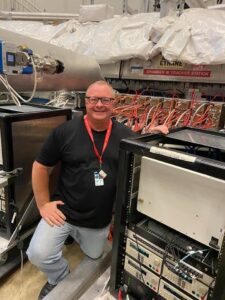
“It’s real Ant-man kind of stuff,” said Brendan, whose passion for physics research began as an undergraduate at Mary Washington. Now a senior scientist at Fermilab, a particle physics and accelerator laboratory in Illinois, he oversaw a team of 200 scientists who carried out the final phase of the experiment.
Unlike the Marvel movie, where characters shrink themselves to enter the quantum realm, Brendan and his team made and measured muons – tiny particles that could change our understanding of the universe and the standard model of particle physics. The award they earned this spring places them alongside some of the world’s most renowned physicists, including Stephen Hawking, Jocelyn Bell Burnell, and Kip Thorne.
“This is one of the greatest collaborations of all time,” Brendan said. The research for the Muon g-2 experiment began nearly 60 years ago at CERN, a lab in Geneva, Switzerland; continued in Brookhaven, Long Island, in the 1990s; and eventually moved to Fermilab. All three facilities were recognized with the Breakthrough Prize for their contributions, sharing the $3 million prize that comes with the award.
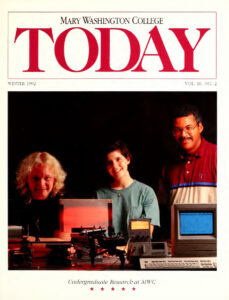
Brendan, who grew up in Massapequa, Long Island, learned about Mary Washington from a high school teacher who was from Fredericksburg. When he visited during the spring semester, Ball Circle was buzzing with energy and bodies in motion, as students played frisbee and sunbathed. “It just felt like the right place for me,” he said.
He planned to study psychology, but a physics class taught by Professor Emeritus Bulent Atalay made him realize what mattered to him.
“Dr. Atalay covered art, culture, and science, webbing it together into this beautiful story,” Brendan said. “And I interact with people from different countries and disciplines, so having a liberal arts education helps me understand where others are coming from and explain my own perspective.”
He served as class vice president and president and played men’s rugby for his first couple of years of college. During his junior year, however, he was pulled toward research and found his purpose. Soon, he was spending day and night in the lab, exploring particle-wave duality, general relativity, and the curvature of time and space.
“That launched me toward the career path I’ve been on ever since,” said Brendan, who presented his findings at undergraduate research conferences with his faculty advisor, Professor Emeritus George King III, and won a competition for best paper.
He then earned a master’s degree at San Francisco State University and a Ph.D. at the University of Hawaii. After post-doctoral research at Brown University, he joined Fermilab, where the team was looking for its next major project.
“My colleagues and I pushed for muons,” said Brendan, who helped secure funding, develop new technologies, and assemble a group of talented researchers. “My goal is always to be the worst physicist on a team of superstars. And everyone became even better.”
They needed to be. The experiment involved moving a massive superconducting magnet known as “The Ring” – so large that it occupied four highway lanes – from New York to Illinois. The team studied traffic routes, weather patterns, and even wave heights to transport the technology across state lines.
“It felt like the most challenging escape room ever,” Brendan said. “But time doesn’t run out, and you’re working with the most incredible group of people and celebrating every win together.”


He plans to build on the momentum with more muon research and a program exploring neutrinos – tiny, neutral particles that have no mass and ignore electrical and magnetic fields. He also hopes to foster future collaboration between Mary Washington and Fermilab.
“We have spots for undergraduates to do summer research,” he said. “If you want to break the laws of particle physics and answer the most challenging questions in the universe, there’s only a few places in the world where you can do that.”
Brendan shared his experiences with UMW students – who learn about the Muon g-2 experiment in their introductory physics lab – when he returned to his alma mater for the Research and Creativity Symposium in 2025.
“We want our students to be aware of the most exciting developments in these fields and emphasize that they can be part of the scientific endeavor,” Assistant Professor of Physics Varun Makhija said. “Hearing about Dr. Casey’s journey showed them the level of scientific contribution that they could be capable of in the future.”
-Article written by Assistant Director of Advancement Communications Jill Graziano Laiacona ’04