Uncategorized

Alumna makes plans to create a third family scholarship through her estate

Heritage Society member Sue A. Tillery ’81 is proud to continue in her father’s footsteps by supporting students at Mary Washington. Her father, Franklin E. Tillery, was the brother of a Mary Washington alumna, the parent of two Mary Washington alumnae, and a longtime member of the UMW Heritage Society.
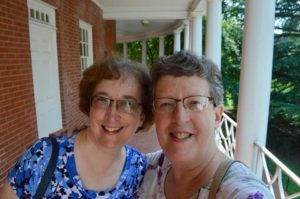
Tillery Sisters
Sue A. Tillery ’81 and her sister, Margaret Tillery Bell ’78, visit UMW in 2018.

Sue recently completed provisions within her estate that will create a new scholarship for music students to recognize both talent and academic merit.

“Dad was just an ordinary, middle-class person,” says Sue. “He always wanted to do his part in helping people who might not get help otherwise, and I’m glad to carry on that legacy.”

In 1981, Franklin E. Tillery established a scholarship in his name to support students with high academic merit at Mary Washington. A few years later, he created the Elizabeth P. Tillery Scholarship in Music to honor the memory of his late wife. He also created named scholarships at other universities with family ties, including the College of William and Mary and the University of Michigan.

A native of Hampton, Virginia, Frank attended the Newport News Shipyard Apprentice School, served in World War II, and then attended the University of Michigan. After receiving a degree in nuclear engineering, he devoted his career to the Newport News shipyards.

Frank’s first introduction to Mary Washington was in the mid-1940s when he came to Fredericksburg to visit his sister, Jeanne Tillery Vesey ’46. Back home in Hampton, he met Betty Poe, a college graduate from North Carolina and a human computer/mathematician at NASA Langley Field (NACA). Betty loved music and sang in the church choir. The couple married and had three children, all of whom shared a love for music.
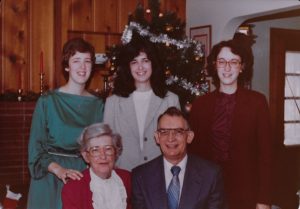
The Tillery Family
Margaret, Jo, and Sue celebrate Christmas in 1982 with their parents, Betty and Frank.

In the 1970s, two of three Tillery children, Margaret Tillery Bell ’78 and Sue, came to their aunt’s alma mater to attend a Governor’s School summer session. With the offer of academic scholarships, they each enrolled at Mary Washington and pursued double majors in music and mathematics. The youngest daughter, Mary Jo Tillery Nidiffer, opted for William and Mary and majored in music and economics. All followed their father’s practical advice to study and enjoy music, but “be sure you have something to earn a living with.”

Sue was a regional scholar at Mary Washington and also received the Aurelia B. Walford and the Anne Hamer Scholarships. She played violin in the orchestra, was a member of Phi Beta Kappa and Mortar Board, and was president of the Music Educators National Conference (MENC).

“I have many fond memories of my college years – recitals in Klein; music classes in Pollard; math, computer, and physics classes in Combs; and watching ‘Dallas’ on Friday nights with other Mary Ball residents,” says Sue. “Overall, the academics and arts at Mary Washington were just the right fit for me.”

After graduating with a double major and teaching certificates in both music and mathematics, Sue accepted a position as a computer programmer with IBM in Gaithersburg, Maryland. She planned to work there only until a teaching position became available; however, she soon discovered she enjoyed the work. She continued her career in the computer industry, working on major government contracts and for well-known corporations in Maryland, Virginia, and Washington, D.C.

While Sue utilized her math skills at work, she shared her other talents by offering private music lessons and participating in church choirs, directing handbells, and leading youth and children’s choirs. For 26 years, she also served as the minister of music for the Viers Mill Baptist Church in Silver Spring, Maryland.
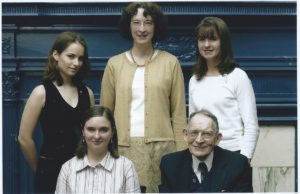
2005 Donor Appreciation Luncheon
Frank Tillery (bottom right) and Sue (center) pose with Tillery scholarship recipients in 2005.

Before her father’s passing in 2007, Sue often accompanied him back to Mary Washington when he met scholarship recipients at various events, including the annual Donor Appreciation Luncheon. “He really liked visiting with the students,” says Sue. “Many wrote him years after they graduated to invite him to weddings, share their career successes, and even to send photos of their own children.”

In the four decades since Frank established the first Tillery scholarship at Mary Washington, more than 75 UMW students have directly benefitted from the financial support – many for multiple years.

“It makes me feel good to follow in Dad’s footsteps,” says Sue. “I have faith and trust in the way the UMW staff has administered the Tillery scholarships. I decided this was an ideal way to leave a legacy in my family’s name while helping academically strong students find their career paths in music.”

Bequests to Mary Washington can support a variety of programs that have direct impact on student success. Contact the Office of Gift Planning at 540-654-2064 to discover how you can leave a legacy in a way that is meaningful to you.


Article written by Donna Harter, Executive Director of Advancement Initiatives
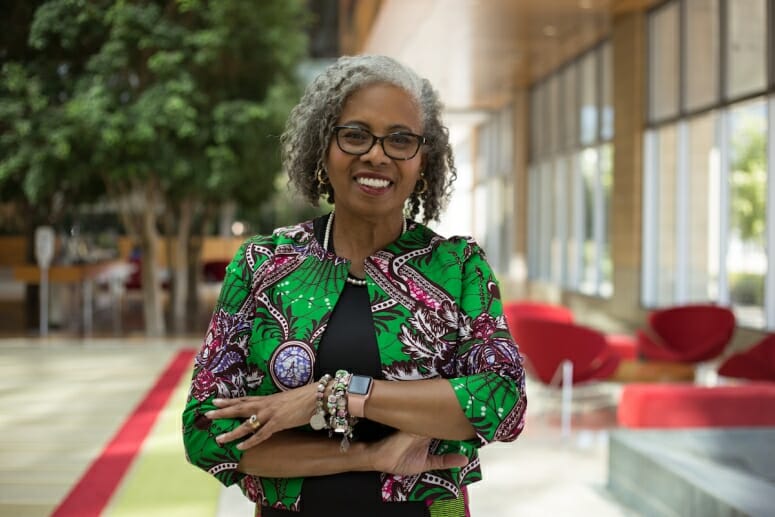
UMW College of Education Hosts Virtual Visit with Award-Winning Educator and Author

Gloria Ladson-Billings Welcomes Students into Her Home

They read her book and learned about her life, teaching methods, and research. Recently, more than 65 UMW education students and faculty members enjoyed an up-close-and-personal virtual visit with Dr. Gloria Ladson-Billings.
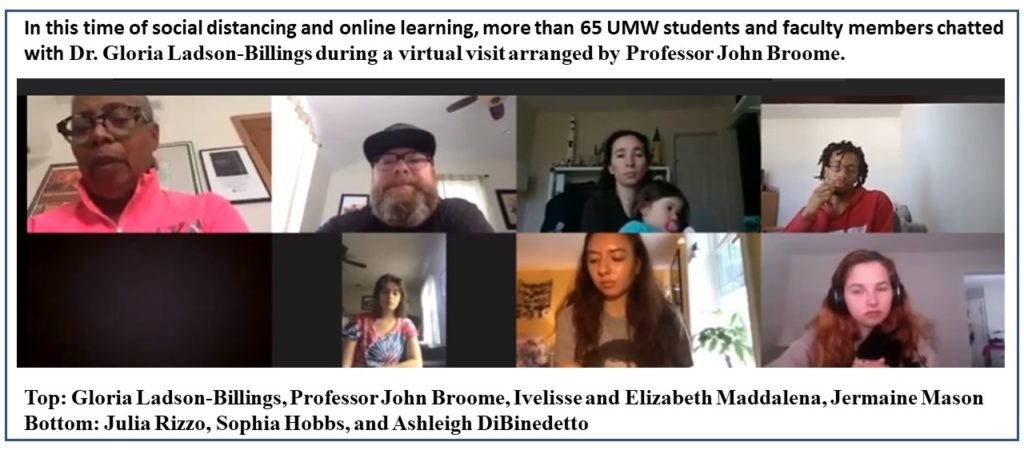
College of Education Professor John Broome says students in his Introduction to Teaching and Learning and Managing the Secondary Classroom courses had been reading The Dreamkeepers: Successful Teachers of African American Children. After one of the classes finished an online discussion from their individual spaces of social distancing, Ladson-Billings joined the virtual classroom from her home in Madison, Wisconsin.

“Gloria is literally one of the most famous, influential, and impactful education theorists and researchers in the world,” says Broome. “I wanted to do something special for my students, so I arranged a surprise to enable them to have some private time with her. She was happy to do it. I truly expected she would chat a few minutes, since she is always busy writing and editing books and articles, but she seemed to enjoy talking and answering their questions. At the end of the 90-minute virtual visit, my students were just shocked and smiling.”

Ladson-Billings spoke at Mary Washington in 2017 when she served as UMW’s Educator-in-Residence, and Broome has maintained contact with her since. During last week’s virtual visit, she responded to UMW student questions and offered real-world advice – from avoiding labeling young students with terms like “high risk,” to being fair and equitable in the application of classroom rules.

Virtual Classroom Visit

Overall, she advises future teachers, “Let your students know that you are human and have feelings, and then treat them as if they have feelings too. Remember, you are interacting with young human beings at one of the most critical points in their lives.”

She adds, “Teachers play a pivotal role, and it truly is important work. Don’t ever let anyone tell you it’s not!” Click here to read more about Gloria Ladson-Billings.

In addition to teaching education classes at UMW, Broome also has become a valued advisor to other educators as they adapt to teaching online during the worldwide COVID-19 pandemic. Recently, Broome was recognized for his leadership in launching the Higher Ed Learning Collective to share high- and low-tech remote-teaching tools for educators. The Collective currently has 25,000 members in 100 countries. Click here to read more about John Broome and the Higher Ed Learning Collective.

Celebrating and Teaching the Arts

While the month winds down and we’re all consumed with information about COVID-19, March gives us something to celebrate – Arts Education Month, and a teacher’s dedication to students.

Carole Garmon’s career – and art – is best described as one and the same.

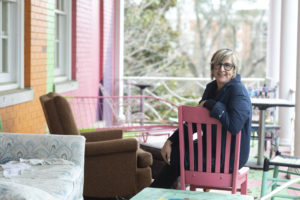
Professor of Art Carole Garmon

Professor of Art Carole Garmon

The longtime UMW professor of art views the world through a visual lens, believing the creative process fuels the imagination. “We have to allow ourselves to imagine things beyond the tangible. Art is beautiful and sometimes challenging,” she said. “But it’s always a reflection on the self.”

A Texas native, Garmon was reflecting on her own future when she moved to Virginia to earn an MFA in sculpture at VCU. She came to work at Mary Washington in 1998, hired to update the sculpture area in Melchers Hall. Presented with a blank canvas, she was charged with creating – almost from scratch – a studio art program, which she says champions art as a career and a lifestyle, not “merely a lifelong appreciation.”

Her stance is the perfect portrait for March, Arts Education Month.

Garmon’s love of teaching is as extraordinary as her passion for artmaking. “Curiosity and wonder” are what drive her. Teaching allows her to constantly channel the creative process, even when she’s supposed to be sleeping.

“I’ll wake up in the middle of the night and brainstorm possible solutions for students,” she said.

Garmon is one of only two Americans chosen to participate in the international exhibition, Inspired By Rembrandt, commemorating the celebrated artist’s 400th birthday. Her work has been shown in D.C., San Antonio, New York, Peru and Berlin, with an upcoming exhibit in New Orleans.

She loves seeing former students’ art, too, around the world. She’s never surprised but always amazed.

“Some students say I act like they can do anything,” Garmon said. “What’s the alternative? Nothing?”

Q: What’s the most rewarding part of your job?
A: I work with talented students and faculty who recognize the importance of art and commit to a life that some view as “not as relevant” as traditional life goals.

Q: Most challenging?
A: Getting students comfortable with risk-taking, even failure. We learn a lot through these experiences; I’d say more so than from our successes. Think masterpiece, risk failure.

Q: How do you teach art virtually?
A: For many, it’s a first. My classes voted on how to proceed. We upload and comment on images through Canvas. My assignments provide openness, empowering students to push creativity while working away from the studio. They’re resilient and eager to keep learning. They’ve blown me away. A student who finally made it back to California just told me she had to bend her artwork to get it on the plane. We do what we have to do.

Q: Your favorite work of art?
A: Donatello’s sculpture of David. He’s far from the traditional heroic approach. When I saw him in an art history class, I couldn’t take my eyes off him. He blurs gender; the epitome of ambiguity. As photographer Sally Mann says, “If it doesn’t have ambiguity, why bother?”

Q: A mantra you live by?
A: “Never ask permission to take up space” and “If you’re asking the question, you already know the answer.”

Garmon asked to include a special addendum for this uncertain time:
“If you will stay close to nature, to its simplicity, to the small things hardly noticeable, those things can unexpectedly become great and immeasurable.” ― Rainer Maria Rilke, Letters to a Young Poet

Article written by Grace Winfield. First published in Eagle Eye 3/26/20.

2020 Giving Day Postponed

The University of Mary Washington has postponed its fourth annual day of online fundraising, Mary Wash Giving Day, originally set to take place Thursday, March 19.

In light of the unparalleled impact of the novel coronavirus (COVID-19) on UMW, the Fredericksburg community – and the nation, the University instead encourages its constituents to focus on each other, their loved ones, and their communities.

The generosity of UMW alumni, students, parents, faculty, staff and friends during past Giving Days has made a vast impact on the University’s mission and ability to serve students. The University will consider rescheduling Giving Day at a future point in time.