John C. and Jerri Barden Perkins '61 CAS Student Research Endowment

UMW Students Earn Perkins Awards at Summer Science Institute Symposium

One of senior Kate Green’s favorite activities this summer was wading in the Potomac and Rappahannock rivers. Swimming in the cool, chin-deep waters, she collected specimens to study how parasites differently impact male and female freshwater snails.

“From biodiversity to human recreation, aquatic ecosystems play an important role in the lives of many different species,” said Kate, a University of Mary Washington conservation biology major, who pursued a completely novel research topic this summer. “My studies will help us obtain a fuller picture of how healthy our beloved rivers are.”

Kate was one of two students who took home the top prizes this year during UMW’s 25th annual Summer Science Institute (SSI), which engages undergraduate STEM students in a 10-week intensive research experience alongside their professors and peers. At a public symposium held July 24 in UMW’s Hurley Convergence Center, Green and her lab partner, biology major Morgan Hicok ’25, earned scholarship awards through the John C. and Jerri Barden Perkins ’61 College of Arts and Sciences Student Research Endowment. The funds will help them continue their research during the upcoming academic year.

Earth and environmental sciences major Joseph Gasink ’26 took second place, evaluating the impact of trace metals on invertebrates in a tidal marsh near a former coal-tar creosote plant. Joining him as runner-up was physics major Boone Fleenor ’26, who hypothesized that drones might be an effective tool to improve water circulation. They will also receive funding through Dr. Perkins’ endowment.

“I appreciate the role SSI plays in advancing student hands-on research so they can understand our world, gain valuable experience, develop critical thinking skills, and ignite their passion for science,” Dr. Jerri Barden Perkins ’61 said. “These inspired minds will shape the future with groundbreaking discoveries, improve healthcare, and address global challenges.”

Dr. Perkins earned a bachelor’s degree in chemistry at Mary Washington and a medical degree from the Medical College of Virginia. She conducted groundbreaking research on rheumatoid arthritis at the National Institutes of Health and reviewed clinical data at the U.S. Food and Drug Administration to protect patients in clinical trials.

“As a woman entering the scientific field, I find Dr. Perkins incredibly inspirational,” said Kate, also praising the late Irene Piscopo Rodgers ’59, who left UMW a transformational $30 million estate gift for scholarships and undergraduate scientific research. The University named the program for Rodgers in a ceremony on Wednesday. “I’d like to wholeheartedly thank both donors for their contributions to UMW and undergraduate STEM students, as well as to the growth of SSI.”

Morgan, who worked alongside Green and Associate Professor of Biological Sciences Abbie Tomba, researched how parasites called trematodes can affect freshwater snails and their ability to fight against a current in aquatic ecosystems.

“Climate change is beginning to affect water levels and flow due to extreme weather,” said Morgan, who will use the Perkins award to continue experimentation and hopes to eventually attend graduate school. “This experience has helped guide my aspirations and my passion for research.”

SSI has grown exponentially throughout the past quarter century, with more than 500 students engaging in the program since its inception. Alumni participants in the program recently returned to campus for a luncheon that connected them with current scholars, faculty mentors, and industry professionals.

Professor Emeritus of Chemistry Ray Scott, who attended the symposium, secured the original grant from DuPont, which helped launch the program. Funding from generous donors, as well as the Naval Surface Warfare Center, Dahlgren Division, has helped this year’s SSI participants engage in extensive research on a broad range of topics across disciplines.

Thirty students shared their findings through oral and poster presentations during Wednesday’s symposium. In labs and in the field, they discovered solutions to real-world issues, exploring breast cancer cell proliferation, electron dynamics, demographic shifts, myotonic dystrophy, decaying dark matter, how toxic pollutants affect the dopamine system, and more.
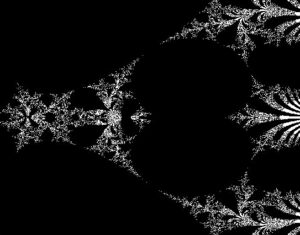
Benjamin Plonka '27 and Sophie Jensen '27 created intricate fractal patterns in their investigation of tetration, or repeated exponentiation. Photo courtesy of Benjamin Plonka.
Benjamin Plonka ’27 and Sophie Jensen ’27 created intricate fractal patterns in their investigation of tetration, or repeated exponentiation. Photo courtesy of Benjamin Plonka.

But mathematics major Benjamin Plonka ’27 said he pursued his project purely because of his passion. He and research partner Sophie Jensen ’27 investigated the concept of tetration, or repeated exponentiation, and visualized its behavior on a real and complex plane to see what intricate structures it can create.

“If we only study the world through the lenses of how it can serve us,” Benjamin said, “we deprive ourselves of seeing some pretty amazing things.”

Learn more about the College of Arts and Sciences’ Irene Piscopo Rodgers ’59 Summer Science Institute.

– Article by Assistant Director of Advancement Communications Jill Graziano Laiacona ’04
 

UMW’s Summer Science Institute Naming Honors Irene Piscopo Rodgers ’59

The University of Mary Washington’s Summer Science Institute (SSI) has given UMW students the chance to conduct trailblazing undergraduate STEM research – analyzing cancer cells, carbon dioxide reduction, and complex computer coding – for a quarter of a century.

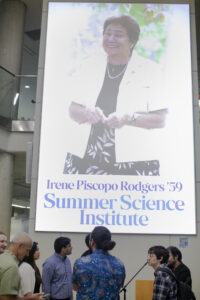
UMW named its 10-week undergraduate STEM research program the Irene Piscopo Rodgers '59 Summer Science Institute at a ceremony in the Hurley Convergence Center lobby during SSI's annual symposium on Wednesday. The late donor left her alma mater a transformational $30 million estate gift for undergraduate scientific research and scholarships. Photo by Karen Pearlman.
UMW named its 10-week undergraduate STEM research program the Irene Piscopo Rodgers ’59 Summer Science Institute at a ceremony in the Hurley Convergence Center lobby during SSI’s annual symposium on Wednesday. The late donor left her alma mater a transformational $30 million estate gift for undergraduate scientific research and scholarships. Photo by Karen Pearlman.

Many of these young scientists had access to their summer studies because of the scholarships, research fellowships, and scientific presentation grants funded by Irene Piscopo Rodgers ’59. UMW named the program the Irene Piscopo Rodgers ’59 Summer Science Institute at a ceremony in the Hurley Convergence Center lobby during SSI’s annual symposium on Wednesday.

“Irene had a long history of supporting STEM majors in pursuing their passion through research,” said College of Arts and Sciences Dean Keith Mellinger, who outlined the history of SSI and recognized the more than 500 students who have participated in research with UMW faculty since its inception. The transformational $30 million estate gift she left the University has resulted in noticeable growth for the program, especially in the last couple of years, he said, from 14 students in the late 1990s to 30 students this summer. “And this trajectory will continue. More faculty, more students, more projects, more lives changed.”

Before Board of Visitors Rector Devon Williams Cushman ’93 read the board resolution, Dean Mellinger thanked Professor Emeritus of Chemistry Ray Scott, who attended the ceremony, for securing the original grant from DuPont and launching SSI. “The program has a history of setting students up for success in graduate and professional study, as well as a seamless entry into any number of careers,” Dean Mellinger said.

Since 1999, SSI’s 10-week program has offered undergraduate students the opportunity to work closely alongside their professors and peers, now in the areas of biology, chemistry, physics, computer science, mathematics, and Earth and environmental science. Funding from generous donors, as well as the Naval Surface Warfare Center, Dahlgren Division, has helped these students engage in extensive research on a broad range of topics across disciplines.

At the symposium, participants summarized their findings through oral presentations and poster sessions, providing solutions for real-world concerns such as preventing breast cancer cell proliferation and exploring how environmental pollutants impact aquatic life. Other projects delved into dark matter, studied skeletal muscle function, explored how to make computers more efficient, and mined data to understand nationwide teaching shortages and demographic changes over time.

Morgan Hicok ’25 and Kate Green ’25, who both studied freshwater snails, earned top prizes. Joseph Gasink ’26, who researched the impact of trace metals on aquatic life, and Boone Fleenor ’26, who studied how drones can impact water circulation, were selected as runners-up. All received awards through the John C. and Jerri Barden Perkins ’61 College of Arts and Sciences Student Research Endowment, which provides funding for them to continue their studies during the academic year.

Dr. Jerri Barden Perkins earned a bachelor’s degree in chemistry at Mary Washington and a medical degree from the Medical College of Virginia. She conducted groundbreaking research on rheumatoid arthritis at the National Institutes of Health and reviewed clinical data at the U.S. Food and Drug Administration to protect patients in clinical trials.

“We’re so grateful to both of these women, Dr. Perkins and Irene, for their extraordinary philanthropy and dedication to advancing scientific education and research,” said Vice President for Advancement and Alumni Engagement Katie Turcotte. “Their stories of being women in male-dominated fields and overcoming obstacles to find success have and will continue to profoundly inspire our undergraduate students and faculty in their own pursuit of scientific knowledge.”

Irene Piscopo Rodgers earned a bachelor’s degree in chemistry from Mary Washington, followed by a master’s degree in chemistry from the University of Michigan. She became a revered electron microscopist, working at the American Cyanamid Company and Philips Electronic Instruments.

As one of the few women her profession, she helped pave the way for current UMW students, especially women, to excel in STEM subjects of their own choosing. To date, more than 100 students have benefited from her generosity. In 2004, Irene donated a transmission electron microscope to UMW, teaching students and faculty how to use it. A decade later, the University awarded her an honorary Doctor of Humane Letters degree for her service and contributions to the institution. Her estate gift also helped establish four new full-ride Alvey Scholarships for out-of-state students, in addition to eight she created during her lifetime.

Learn more about the College of Arts and Sciences’ Irene Piscopo Rodgers ’59 Summer Science Institute.  

– Article by Assistant Director of Advancement Communications Jill Graziano Laiacona ’04

STEM Students Share Gratitude at UMW’s Celebration of Giving

One of Hannah Stottlemyer’s most memorable moments at the University of Mary Washington came on a Global Medical Brigades trip to treat underserved communities in Panama. There, she put her majors in biomedical sciences and Spanish into practice when she extracted a patient’s tooth and watched his sudden relief.

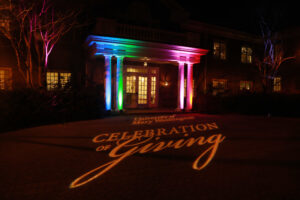
The Celebration of Giving, held on Dec. 6, honored Irene Piscopo Rodgers '59 and other Mary Washington alumnae who majored in the sciences and gave back to support the University and STEM students. Photo by Karen Pearlman Photography.
The Celebration of Giving, held on Dec. 6, honored Irene Piscopo Rodgers ’59 and other Mary Washington alumnae who majored in the sciences and gave back to support the University and STEM students. Photo by Karen Pearlman Photography.

Having this experience as an undergraduate was possible because she earned an Alvey Scholarship, she said, providing her with full tuition, fees, and room and board. “I feel such gratitude toward my donor,” said Hannah, a Mary Washington senior who plans to apply to dental school this spring. “She achieved success and decided to selflessly invest in UMW students to ensure they also have opportunities to succeed.”

At the Celebration of Giving, Hannah shared her story, honoring her late donor, Irene Piscopo Rodgers, who passed away in July 2022. The 1959 alumna left the University a transformational $30 million estate gift for undergraduate STEM research and to establish four new Alvey Scholarships for out-of-state students, in addition to the eight she created in her lifetime. This year’s event, held Dec. 6 at UMW’s Jepson Alumni Executive Center, focused on the tremendous impact that Irene and other alumnae in the sciences have made at Mary Washington by prioritizing the University in their philanthropic giving.

“They overcame obstacles at a time when there were few women in STEM, found success in their fields, and gave back to their alma mater so students could follow their dreams and change the world,” said Vice President for Advancement and Alumni Engagement Katie Turcotte, who shared highlights from the past fundraising year and thanked those who donated in 2023.

2023 marked the most successful fundraising year in Mary Washington’s 115-year history, she told the 200-plus guests in attendance, who contributed toward the $21.3 million raised in donations and pledges over the past year in support of UMW students, faculty, and programs. “Through your philanthropy, your volunteerism, and your engagement, you have given so much back to the University, and our students see that and are inspired by each of you.”

Seated at tables adorned with microscopes, drones, and beakers and flasks filled with colorful liquids, guests embraced the evening’s science theme, especially a chemistry concoction for dessert created by UMW Catering. Showcasing a broad liberal arts and sciences education, junior Sasha Murphy, a biochemistry major and neuroscience minor, played flute, accompanied by Department of Music Professor and Chair Brooks Kuykendall on piano. Attendees then listened as a series of speakers thanked donors for their contributions.

“When you invest in a student’s education, it not only transforms their lives, but they have the opportunity to go out and pay it forward,” President Troy Paino said. “You model exactly what we hope to instill in our students.”

Ron Pohl, Irene’s attorney and friend, spoke about how Mary Washington transformed her life. “Nothing made her happier than giving money to this school, creating Alvey Scholarships, seeing students get their tuition paid for, and watching them grow up and have careers,” he said.

Guests also heard from several recipients, including Harrison Miles, a 2015 alumnus pursuing a post-baccalaureate degree in conservation biology. His research using fungus extracted from the invasive spotted lantern fly earned him the John C. and Jerri Barden Perkins ’61 College of Arts and Sciences Student Research Fellowship at this year’s Summer Science Institute.

“Dr. Perkins, I’m incredibly grateful to you for recognizing my research and for the invaluable role you played in my Mary Washington journey,” said Harrison, who will begin a Ph.D. in forestry this spring. “Thank you for contributing to my undergraduate education and that of so many others at UMW.”

Senior Sofia Taylor, who received an Alvey Scholarship to study psychology, neuroscience, and music, spoke about her close relationship with her benefactor, who often kept up with her recipients through emails, cards, and letters.

“Irene, I hope you know that everything I’m doing here at UMW was made possible because of your generosity,” Sofia said. “I will continue to make you proud as a woman in STEM and sing your praises for all past and future Alvey Scholars to hear.”

Learn more about establishing scholarships and how private support makes a difference in the lives of UMW students who receive scholarships, research fellowships, and internship grants.

View photos from the 2023 Celebration of Giving.

– Article written by Assistant Director of Advancement Communications Jill Graziano Laiacona ’04 

Why I Give: Jerri Barden Perkins ’61

Jerri Barden Perkins, MD, came to Mary Washington aspiring to become a doctor. Growing up in a home where money was tight, a “small scholarship” of $100 made a huge difference, she said.

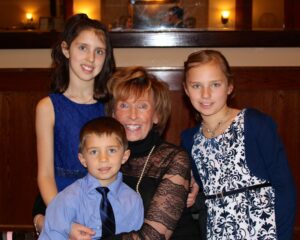
Jerri with her grandchildren

Now she’s helping current students succeed through her own gifts to UMW, including the John C. and Jerri Barden Perkins ’61 College of Arts and Sciences Student Research Endowment, which awarded scholarship funds to rising seniors Ava Spencer ’23 and Kevin Leong ’23 at the 2022 Summer Science Institute in July.

“At Mary Washington, I found the best possible education and professors who ensured that I was prepared for my career,” said Jerri, who paid her way through college with government loans and part-time jobs. A chemistry major, she says her liberal arts and sciences education also exposed her to lifelong passions like opera, art, dance, and golf.

Jerri later attended the Medical College of Virginia in her hometown of Richmond and earned a postdoctoral fellowship at the National Institutes of Health, where she conducted trailblazing research on rheumatoid arthritis. She then became an FDA medical officer, recommending approval for one of the first drugs to combat AIDS. She presented her work around the world and opened Perkins & Perkins, a consulting firm to protect the rights of patients in clinical trials, in partnership with husband Cal, a Harvard grad who practiced internal medicine.

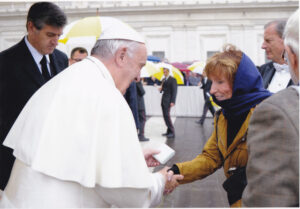
Jerri meeting Pope Francis several years ago in Rome, which she says was one of the highlights of her life.

Her first gift to Mary Washington was in the same amount as that scholarship that helped her get started as an undergrad all those years ago – but she didn’t stop there. She soon funded one in her own name and became a member of UMW’s Washington and Heritage societies.

“Whenever students phoned to ask for donations, Cal always encouraged them to call me Dr. Perkins,” she said. “We attended a study abroad luncheon once, and he was so impressed with the quality of education at Mary Washington. He told me that my school would benefit more from our gifts than Harvard.”

When Cal passed away in 2009, Jerri worked with UMW’s Jan Clarke to establish three endowments in her late husband’s honor. One provides funds for UMW students studying abroad, while another supports the Classics, Philosophy, and Religion department, one of Cal’s particular areas of interest.

Helping Mary Washington students succeed is incredibly rewarding, she said. “It brings me such joy to support students during my lifetime.”

Q: What would you say to fellow alums who are considering endowing a scholarship?
A: Do it now so you can see the benefits and help UMW students learn and grow just the way you did.

Q: What’s your most meaningful Mary Washington memory?
A: Receiving the Distinguished Alumna Award in 2019.

Q: Where did you like spending time on campus?
A: I loved the library in Trinkle (now James Farmer Hall) as a student. I have donated artwork that’s now in the Classics department and love visiting the Zen Garden outside the building.

Jerri with President Troy Paino, Jay Sinha '07, and Abas Adenan '85, after receiving Alumni Association Awards at Reunion Weekend in 2019.
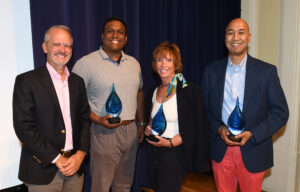
Jerri with President Troy Paino, Jay Sinha ’07, and Abas Adenan ’85, after receiving Alumni Association Awards at Reunion Weekend in 2019.

Q: What was your favorite Mary Washington tradition?
A: Celebrating May Day. I love the campus when it’s in full bloom. I had a professor who taught astronomy, and I can recall stargazing on a spring night.

Q: How do you spend your free time?
A: Sailing, skiing, biking, and traveling. I’m excited to return to Paris this fall and recently went sailing near my home in Hilton Head, South Carolina, with Jan Clarke and Vicki Sprague Ravenel ’77.

To learn more about establishing scholarships, please contact the Office of University Advancement at (540) 654-1024 or advance@umw.edu.

This story originally ran in the Advancing Mary Washington newsletter and was written by Assistant Director of Advancement Communications Jill Graziano Laiacona ’04. 

Summer Science Students Earn Perkins Research Awards

As temperatures soared near triple digits last Wednesday, the weather formed a compelling case for Ava Spencer’s research on how extreme heat impacts Fredericksburg’s most marginalized communities.

“I wanted to look at these issues from a sociological perspective, in a way that could help people,” said Ava, a rising senior majoring in environmental science at the University of Mary Washington.

She was one of a pair of students who took home the top prizes at UMW’s Summer Science Institute (SSI), which engages undergraduates in an intense 10-week research experience with professors and peers. At a public symposium held in the Hurley Convergence Center’s Digital Auditorium, she and physics major Kevin Leong were chosen by a panel of faculty judges to each receive a scholarship award through the John C. and Jerri Barden Perkins ’61 College of Arts and Sciences Student Research Endowment. The funds will help the students continue their projects through the upcoming school year.

Second place winners were Curtis Kasiski for his research on determining the dietary diversity of bumblebees, and Orianne Mbuyi Mujinga Kazadi for her work identifying fungal strains that can destroy invasive spotted lanternflies.

“I hope this award inspires them to open their minds to possibilities in life,” said Dr. Jerri Barden Perkins, who watched the presentations via Zoom. She was amazed at the variety and relevance of topics, she says, from fighting antibiotic resistance with phage therapy to using sockets to create video games. “The liberal arts and sciences education students find at Mary Washington broadens their perspectives and prepares them for the real world.”

Dr. Perkins earned a bachelor’s degree in chemistry at Mary Washington and a M.D. from the Medical College of Virginia. She went on to conduct her own trailblazing research into rheumatoid arthritis and approved one of the first FDA drug therapies to combat AIDS. Her endowment, one of several she established at UMW, is in honor of her late husband, Cal, who practiced internal medicine.

“The Perkins scholarship award will allow us to recognize UMW students demonstrating exemplary performance,” said College of Arts and Sciences Dean Keith Mellinger. “This elevates SSI to a professional level.”

Kevin, a rising senior, received the “Best Poster” award for his creation of a solar-powered cell phone charging station for homeless people. Working with Assistant Professor of Physics Desmond Villalba, he used a 3-D printer, and created and programmed circuits, to assemble a functioning prototype he hopes can be replicated in Fredericksburg.

“I feel so honored to have won the Perkins award,” said Kevin, adding that SSI has inspired him to pursue a career or further education in research. “The entire experience has been fantastic.”

Ava, who won the “Best Presentation” award, collaborated with Assistant Professor of Environmental Science Pamela Grothe ’06 and a team of volunteers to map temperatures across Fredericksburg.

They discovered that some neighborhoods historically zoned for African Americans were up to five degrees warmer than others due to lack of tree canopy and green spaces. “Research like this has been performed in larger cities, but not smaller communities like ours,” Ava said.

Receiving the Perkins award, she said, will help her continue the research through the fall semester. She hopes her findings will eventually aid local officials with the city’s climate action plan. “It’s a great feeling to be recognized for a project you’ve poured your time, energy and love into.”

For information on endowing scholarships at the University of Mary Washington, please contact the Office of University Advancement at advance@umw.edu or 540-654-1024.

– Article written by Assistant Director of Advancement Communications Jill Graziano Laiacona ’04