Fund for Mary Washington Impact Grants

UMW’s LaunchPad Program Propels Students to First-Year Success

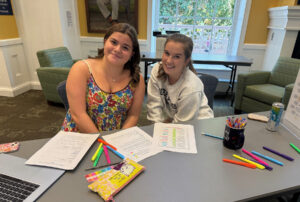
University of Mary Washington first-year student Crow Sindelar spreads out glitter pens and neon highlighters on a table in the Cedric Rucker University Center and begins plugging this semester’s courses into a new day planner.

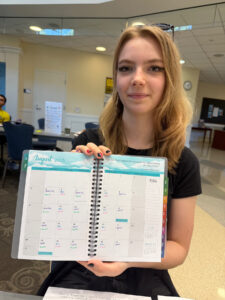
First-year student Crow Sindelar shows off their new day planner provided by the LaunchPad program. Supported by a Fund for Mary Washington Impact Grant, the four-week program gives incoming students a crash course in syllabus organization, time management, campus involvement, and how to utilize computer tools like Canvas and Microsoft Office.

“It’s helpful to review your syllabus and expectations so you can track assignments, midterms, and finals – and make it aesthetically pleasing,” said Crow, a sociology major who color-codes classes in the calendar with sparkly blue, purple, green, and pink ink. “I want to stay organized and manage everything in college.”

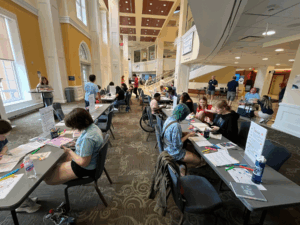
That’s the goal of LaunchPad, a new series of events helping incoming students transition to UMW by building executive functioning and social skills critical for college success. Supported by a Fund for Mary Washington Impact Grant, the four-week program, which concluded last week, offers a crash course in syllabus organization, time management, campus involvement, and using computer tools like Canvas and Microsoft Office.

“College is one of the biggest transitions these students have faced since kindergarten, and they’re navigating it on their own without their parents,” said Melissa Jones, associate vice president of student affairs and dean of students. In her role, Jones leads New Student Programs and co-created LaunchPad with UMW First-Year Experience Director April Wynn. “We want them to know they’re not alone,” Jones said.

Wynn, an associate professor of biological sciences, said LaunchPad emerged from conversations with faculty who noticed students needed help adjusting to post-pandemic college life shaped by new technologies, including discussions around using AI in the classroom.

“These students are part of the Chromebook generation and often have little experience using Microsoft products,” said Wynn. LaunchPad meets them where they are, she said, helping them build the confidence, community, and skills they need to thrive academically and socially.

The first week of LaunchPad saw 225 students attend its sessions on syllabus organization, which also gave them the chance to print syllabi in the nearby Center for Career and Professional Development.

After seeing the success of another donor-funded initiative, Soft Landings, a pre-arrival program for UMW students with autism spectrum disorder, Jones and Wynn, along with Assistant Director of New Student Programs Lillian Lester ’20, secured a $5,000 Impact Grant, which covered peer mentor stipends, day planners and supplies, workshops, outreach, and more.

While LaunchPad is geared toward first-year students, Jones said they hope to plan it around the fall senior class meeting in the future to provide a refresher for soon-to-be graduates. “They’ll need these skills for the workforce, and it aligns with Life After Mary Washington,” she said.

First-year sociology major Jasper Hocker learned about the program from a pamphlet handed out at Orientation. He worked with sophomore peer mentor Eliot Suh, a business administration and accounting major, to print his syllabi at UMW’s Center for Career and Professional Development. “I mostly used Google products in high school, so I’m hoping to attend the Microsoft sessions,” Jasper said.

UMW first-year student Lucy Rabung (left) sought the help of her peer mentor, Lauren Spagnuolo, a sophomore, who helped her organize all her syllabi and record the dates of her assignments in a new day planner provided by LaunchPad.

Lucy Rabung, a first-year psychology major, texted her peer mentor, Lauren Spagnuolo, in a panic after receiving syllabi for five different courses.

“Starting college can be overwhelming,” said Lauren, a sophomore psychology major and disability studies minor, who remembers a peer mentor guiding her as a new student. “I wanted Lucy to know she didn’t have to do it all alone.”

She encouraged Lucy to attend a LaunchPad session, where she helped her break down each syllabus and record due dates in her planner.

“If not for these resources, I’d feel like I was struggling,” said Lucy, whose family and friends at other institutions have been impressed when she’s told them about the program. “Everyone at Mary Washington has made me feel welcome and cared for.”

UMW’s Fund for Mary Washington Impact Grants program is made possible through donors’ gifts to the Fund for Mary Washington. These gifts are vital to the University’s ability to improve the student experience and support faculty, providing crucial flexibility to respond to emerging challenges and seize opportunities as they arise. When alumni, parents, friends, faculty, and staff give to the Fund for Mary Washington, they are choosing to be part of a community that is committed to giving back and making the world a better place – enabling students to make positive change through programs like the Fund for Mary Washington Impact Grants.

– Article written by Assistant Director of Advancement Communications Jill Graziano Laiacona ’04
UMW Physics ‘PING’ Program Inspires High Schoolers, Empowers Future Educators

Tristan Towle and Zubair Mohammadzai take turns lobbing colorful cotton balls at a black canvas hanging in a University of Mary Washington parking deck. The splatters they create with washable paint remind Tristan, a junior at Brooke Point High School, of fireworks, but Zubair has another theory.

“We’ve been talking about stars, red giants and white dwarves,” said the Osbourn Park High School senior, thinking back to the astrophysics lesson led by UMW faculty members as well as current physics majors Hannah Steele, Aliya Ather, and CJ Hulleman. “They look like different colors based on temperature.”

The activity, combining both astronomy and art, is part of Physicists Inspiring the Next Generation (PING), introduced at Mary Washington this summer as an expansion of a program that began at Michigan State University (MSU). For two weeks, regional high schoolers curious about majoring in physics in college are exploring astrophysics, electronics, and computer coding, under the guidance of UMW Physics faculty members.

Supported by a Fund for Mary Washington Impact Grant totaling $4,500, the program also provides stipends for three UMW student mentors majoring in physics and open to teaching at the high school level.

“This program would’ve expanded my avenues if I participated in it during high school,” said Aliya, a Mary Washington sophomore who is serving as a PING mentor this summer. “I’m excited to share my knowledge about physics but also how to collaborate in this field and how important it is to integrate the creative side into physics.”

UMW Professor and Chair of Physics Matt Fleenor estimates that over half of high school physics classrooms in the U.S. are taught by someone without a degree in the field. “So, our aim is to cultivate interest in physics locally among high school students while supporting the potential futures of high school physics instructors,” he said.

Dr. Fleenor reached out to high school physics teachers in the greater Fredericksburg area to recruit applicants, resulting in a cohort of six students in Mary Washington’s inaugural PING program. Statistics show that 80% of UMW physics majors come from a 90-mile radius, he said. “They grow up here, come to school here, and end up teaching or working at Dahlgren or somewhere close by.”

Kenya Wallach, former math and science supervisor for Stafford County Public Schools, had long wanted to bring such a program to the region. Last fall, she and Dr. Fleenor were surprised to discover they were seated in the same row at a conference in Houston, listening to Ms. Wallach’s 16-year-old daughter, Emma, speak about her experiences in PING at MSU.

“From the time my children were little, we talked about physics and mathematics and how they touch every aspect of our lives,” said Ms. Wallach, who leads PING’s parent group, Promoting Opportunities for the Next Generation (PONG). All three of her children participated in the program, and now her 19-year-old daughter is earning a Ph.D. in physics at MSU. “In order to see yourself doing something, you have to see people like you succeeding at it.”

Emma, who is serving as a volunteer mentor, and her mother designed the paintball splatter activity and helped Fleenor create a curriculum that gives participants the chance to create circuits, make measurements, plot graphs, learn Python coding, and explore evolving star clusters using cutting-edge technology. The students are also touring the UMW campus and learning about research Mary Washington students and faculty are doing in the Irene Piscopo Rodgers ’59 Summer Science Institute.

Hannah, a senior mentor who aspires to teach physics after graduating from Mary Washington, learned from Ms. Wallach how to employ an explicit inquiry-based instruction model. By writing in reflection journals and engaging in role-play, the mentors learned how to provide the high school students with a solid foundation for the material and ask guided questions to help them reach their own conclusions.

“It allows them to struggle productively until they find the answer on their own,” said Hannah, who received a Robert Noyce Teaching Scholarship through UMW’s College of Education partnership with the National Science Foundation.

Alexander Rosas, a Stafford High School senior, experienced his own “a-ha moment” while engaging in the physics painting activity. His strategy? Tossing cotton balls dripping with paint to create a grouping resembling a stellar cluster and then reusing them to create a contrast on the other side of the canvas.

“I wanted to show that the amount of energy put into an object correlates to its outcome,” said Alexander, who hopes PING will help him make connections within the physics community in Fredericksburg. “This project showed me a different perspective of what physics could be.”

UMW’s Fund for Mary Washington Impact Grants program is made possible through donors’ gifts to the Fund for Mary Washington. These gifts are vital to the University’s ability to improve the student experience and support faculty, providing crucial flexibility to respond to emerging challenges and seize opportunities as they arise. When alumni, parents, friends, faculty, and staff give to the Fund for Mary Washington, they are choosing to be part of a community that is committed to giving back and making the world a better place – enabling students to make positive change through programs like the Fund for Mary Washington Impact Grants.

-Article written by Assistant Director of Advancement Communications Jill Graziano Laiacona ’04
-Photography by Karen Pearlman ’99/K Pearlman Photography and UMW digital communication major Katie Van Houten ’27

UMW Impact Grants Program Transforms Ideas into Innovation

Amira Said has always been passionate about sustainability, but the junior environmental science major has unearthed new ways to care for her community and the planet since coming to the University of Mary Washington.

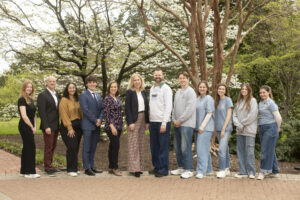
Nine projects and initiatives pitched by UMW faculty, staff, and students earned Fund for Mary Washington Impact Grants after their presentations to the UMW Alumni Association Board of Directors and Young Alumni Council in April. Photo by Karen Pearlman.

“During my first year, I noticed how much food waste was generated,” she said. Building upon the UMW Office of Sustainability’s work – which has earned the University a perennial spot on The Princeton Review’s Guide to Green Colleges – she secured funds last year to place three large compost bins in high-traffic areas on campus.

Yet, Amira wants to go even greener, with plans to engage her fellow students in a hands-on learning experience to promote composting. The Fund for Mary Washington Impact Grant she received this spring will prevent hundreds of pounds of food waste from ending up in landfills, instead producing nutrient-rich recycled matter to use in UMW’s pollinator gardens and on the grounds.

Now in its second year, the Impact Grant program recently awarded over $25,000 in donor-funded grants, ranging from $500 to $5,000, to nine projects pitched by students, faculty, and staff on behalf of recognized campus organizations. Eight initiatives earned funding last year, including Eagles in Recovery, the Charnoff Production Studio, an initiative to dispense free menstrual products on campus and a new program called “Soft Landings,” which helps incoming students with autism spectrum disorder acclimate to Mary Washington.

Applicants were required to submit a video and slide deck, demonstrating financial need and outlining measurable objectives, a detailed budget, a sustainability plan, and a targeted audience. Each project was also evaluated on how closely it aligned with UMW’s ASPIRE values.

Several projects received additional funding from members of the Alumni Association Board of Directors, who joined the Young Alumni Council in selecting the recipients after they gave presentations in April. “Amira was one of the top presenters, clearly and directly answering all questions and making a sound case for support,” said Alumni Board President James Llewellyn ’87, who personally contributed funds to Amira’s project with his wife, Deborah.

UMW student newspaper The Weekly Ringer, the Center for International Education, the new UMW Student Research and Creativity Collaborative, and a summer physics camp for high schoolers run by Mary Washington students also earned Impact Grants. In collaboration with the Eagles in Recovery program (which earned funding last year), Student Government Association Vice President Shadwick Yoder ’25 and SGA Senator Maso Moses ’28 also received an Impact Grant to purchase enough Naloxone (Narcan) kits for each residence hall, providing a life-saving treatment that can reverse opioid overdoses.

Impact Grant recipients have one year to use funds and must participate in a reporting workshop this fall.

Junior Knox McKinley received an Impact Grant on behalf of UMW’s Community Outreach and Resources (COAR), as well as a donation from Alumni Board Immediate Past President Vicki Sprague Ravenel ’77. The student-led service organization plans to make 600 bagged lunches next year for Micah Ministries to feed the area’s unhoused population.

“The application process allowed us to reflect on the service projects we’ve done and brainstorm how we can improve for the future,” said Knox, adding that COAR’s leaders honed critical-thinking, public-speaking and advocacy skills that will benefit them in their careers and lives after Mary Washington.

Assistant Professor of Studio Art Coorain Devin’s Impact Grant will help host a public-facing printmaking celebration next spring called “Print-a-Palooza.” With a rented steam roller, Professor Devin and art students will create large-scale prints to display next year during Devil-Goat Day, marking the 100th anniversary of the uniquely UMW tradition.

“By getting arts out into the community, I’m hoping to get more people involved in arts on campus and to see themselves as artists, even if they’ve never had the chance to take an art class,” said Professor Devin, who will also use funds to help campus organizations utilize printmaking tools.

Dean of Students Melissa Jones and Associate Professor of Biological Sciences April Wynn, who serves as faculty director of UMW’s First-Year Experience, secured an Impact Grant for “LaunchPad.” The new program will teach students executive function and socialization skills that are critical to success in college, such as how to maintain a schedule, track deadlines, employ technology, communicate effectively, and respond to adversity.

“We’re so elated to have received an Impact Grant,” Professor Wynn said. “The program really speaks to the pay-it-forward spirit at UMW, and the way alumni are paving the way for current and future Eagles.”

UMW’s Fund for Mary Washington Impact Grants program is made possible through donors’ gifts to the Fund for Mary Washington. These gifts are vital to the University’s ability to improve the student experience and support faculty, providing crucial flexibility to respond to emerging challenges and seize opportunities as they arise. When alumni, parents, friends, faculty, and staff give to the Fund for Mary Washington, they are choosing to be part of a community that is committed to giving back and making the world a better place – enabling students to make positive change through programs like the Fund for Mary Washington Impact Grants.

-Article written by Assistant Director of Advancement Communications Jill Graziano Laiacona ’04
Impact Grant Supports Eagles in Recovery’s Substance-Free Mission

When the calendar turns to May, Devin Walsh, the University of Mary Washington’s peer recovery specialist, will mark off some significant milestones.

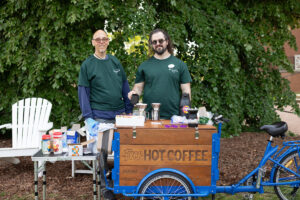
From left: Ray Tuttle, UMW’s health promotions and student success specialist, and Devin Walsh, UMW's peer recovery specialist, run Eagles in Recovery, a program that supports Mary Washington students working to overcome substance and alcohol addiction. A Fund for Mary Washington Impact Grant has supported Devin's position, which also oversees the recovery coffee bike (seen here), providing beverages, education, and outreach to the campus community. Photo by Parker Michel Boyce.
From left: Ray Tuttle, UMW’s health promotions and student success specialist, and Devin Walsh, UMW’s peer recovery specialist, run Eagles in Recovery, a program that supports Mary Washington students working to overcome substance and alcohol addiction. A Fund for Mary Washington Impact Grant has supported Devin’s position, which also oversees the recovery coffee bike (seen here), providing beverages, education, and outreach to the campus community. Photo by Parker Michel Boyce.

Two years ago, he committed to a life of sobriety, and the following spring, he began training to help others overcome their own struggles with substances and alcohol, which can often make it challenging for college students to stay in school.

“The University wants to give its students the best opportunity to be successful in college and beyond,” Devin said. “Being visible and outspoken about my own journey can give them the hope they need to heal and continue to study, learn, and grow so they can achieve their goals.”

Founded in 2017, UMW’s Eagles in Recovery program has provided the campus with critical resources and tools to support students, from the sober-curious to those who have experienced active addiction. Bolstered by a Fund for Mary Washington Impact Grant and other sources of funding, Eagles in Recovery also educates and engages the campus community through initiatives such as the coffee bike – providing hot beverages, snacks, and outreach – and recovery ally training to teach friends and family how to support loved ones while reducing stigmas surrounding addiction.

“Popular culture has perpetuated the idea that college is the best four-year party one can experience,” said Ray Tuttle, UMW’s health promotions and student success specialist. “But if you’re a person in recovery, and you don’t want to be in that kind of environment, it can be very difficult.”

In 2019, Ray helped secure $50,000 as part of the Expanding Collegiate Recovery in Virginia grant, awarded to several schools across the commonwealth by the Department of Behavioral Health and Development Services. The University used the funds to set up a “clubhouse,” a designated safe space in the Link between Randolph and Mason halls, where students in recovery can spend time together in between classes and on weekends, without the risk of being near addictive substances.

Ray and Jiamie Pyles ’23, UMW’s former peer recovery specialist, also earned a Fund for Mary Washington Impact Grant, which provided $5,000 to support the specialist’s position. Piloted by UMW’s Office of Advancement and Alumni Engagement, the Impact Grant program awarded a total of $25,000 in donor-funded grants last spring, ranging from $1,200 to $5,000, to eight projects or initiatives pitched by students, faculty, and staff on behalf of recognized campus organizations.

Devin, who took over the position last year after serving as a volunteer, provides education and outreach through the recovery coffee bike, which he brings to major events on campus like Devil-Goat Day and Club Carnival. He also administers Narcan training to prevent opiate overdoses and oversees group support meetings and one-on-one coaching in the clubhouse.

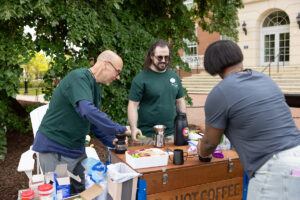
At this year's Devil-Goat Day, Ray and Devin served hot beverages from the recovery coffee bike, while providing outreach to the campus community about Eagles in Recovery and its mission. Photo by Parker Michel Boyce.
At this year’s Devil-Goat Day, Ray and Devin served hot beverages from the recovery coffee bike, while providing outreach to the campus community about Eagles in Recovery and its mission. Photo by Parker Michel Boyce.

“You’re talking to someone who has the professional training but also the lived experience of being in active addiction and working on one’s own recovery,” he said.

Devin also organizes substance-free fellowship events like bowling, camping, and trips to amusement parks, sometimes with other schools, and acts as a liaison with Rappahannock Area Community Services Board and various local nonprofits that serve recovery communities.

He plans to attend professional conferences this summer to learn more best practices for his position.

“A peer recovery specialist is still relatively new in the mental health sector, so there’s always new research to stay on top of,” he said. “We also take a multifaced approach, so it’s coming up with a different action plan for each person.”

The program has seen an uptick in students utilizing its services since Devin came to UMW, so both he and Ray are grateful for the Impact Grant, which was critical for the continuation of the program.

“Part of the vision for Eagles in Recovery is supporting students so they don’t have to choose between their recovery and their academics,” Devin said. “They can have both.”

UMW’s Fund for Mary Washington Impact Grants program is made possible through donors’ gifts to the Fund for Mary Washington. These gifts are vital to the University’s ability to improve the student experience and support faculty, providing crucial flexibility to respond to emerging challenges and seize opportunities as they arise. When alumni, parents, friends, faculty, and staff give to the Fund for Mary Washington, they are choosing to be part of a community that is committed to giving back and making the world a better place – enabling students to make positive change through programs like the Fund for Mary Washington Impact Grants.

– Article written by Assistant Director of Advancement Communications Jill Graziano Laiacona ’04

UMW’s ‘Soft Landings’ Program Smooths College Transition for Neurodivergent Students

Nicole Martin couldn’t wait to begin her college experience at the University of Mary Washington. Yet, as an incoming first-year student, she felt overwhelmed by the thought of a packed schedule of activities, unfamiliar faces, and new situations.

This semester, UMW officially launched 'Soft Landings,' a pre-arrival program to help incoming students with autism spectrum disorder acclimate to the UMW campus. The program was funded through a Fund for Mary Washington Impact Grant, which helped purchase textbooks and pay stipends for mentors.
This semester, UMW officially launched ‘Soft Landings,’ a pre-arrival program to help incoming students with autism spectrum disorder acclimate to the UMW campus. The program was funded through a Fund for Mary Washington Impact Grant, which helped purchase textbooks and pay stipends for mentors.

“Thankfully, I learned about ‘Soft Landings,’ which provided support that I didn’t even know I needed,” Nicole said of UMW’s new pre-arrival program that helps students with autism spectrum disorder (ASD) acclimate to Mary Washington. “It’s made a huge difference in how I’m adjusting to college life.”

As UMW observes Disability Awareness Month in October, Nicole is one of 11 students enrolled this fall in the first cohort of ‘Soft Landings,’ which provides activities and campus tours, as well as personal introductions to key staff members, to help ease the transition to UMW before other students arrive on campus. The program also helps neurodivergent students hone critical skills for college success, such as learning how to solve problems and adapt to new situations, practicing self-care, preparing for academic courses, socializing, and learning to self-advocate.

“UMW has a sizeable population of students with ASD, in part because of our emphasis on small class sizes and individualized attention,” said Assistant Dean of Students Chris “CJ” Porter, who oversees the program. More than 100 current students have disclosed an ASD diagnosis, with 85 seeking accommodations, said Director of Disability Resources Alex Ecklund.

A staff member since 1999, CJ was already familiar with the kinds of challenges that neurodivergent students can face in college, like knowing when to speak up in class, staying on top of assignments, and engaging in social interactions with peers and professors.

“This is the first time many of these students are navigating life on their own,” said CJ, who spent a year researching how to get the program off the ground. “But it’s very expensive to raise a child with special needs, so we needed to find a way to make it affordable for parents.”

Last spring, CJ secured a Fund for Mary Washington Impact Grant through a new program piloted by UMW’s Office of Advancement and Alumni Engagement that awarded $25,000 in donor-funded grants to eight projects and initiatives sponsored by students, faculty, and staff.

The $3,500 grant she received covered the cost of purchasing a textbook, Going to College with Autism, for each student, as well as stipends for five UMW student mentors, all of whom identify as having ASD. Families whose students participate in the program are charged a small fee for meals.

“CJ had seen my work as an orientation leader and thought I’d be a great fit,” said sophomore theatre major Oleander Neleski, who is currently serving as a mentor. “Being neurodivergent, I was able not only to answer questions, but also be an example of someone who’s making it work as a college student.”

The Impact Grant for 'Soft Landings' covered the cost of a textbook, 'Going to College with Autism,' seen here with a collection of fidget toys to help students when they feel overstimulated. The book is filled with success stories of students with autism spectrum disorder. Photo courtesy of CJ Porter.
The Impact Grant for ‘Soft Landings’ covered the cost of a textbook, ‘Going to College with Autism,’ seen here with a collection of fidget toys to help students when they feel overstimulated. The book is filled with success stories of students with autism spectrum disorder. Photo courtesy of CJ Porter.

Nicole said that participating in the program influenced her decision to become a future mentor – and to major in psychology so she can help others with ASD. “I’m also working on creating a campus organization to help neurodivergent students at UMW connect with each other.”

First-year student Lauren Tant appreciated all aspects of the program, from getting a chance to move into her residence hall early to exploring Simpson Library, the Cedric Rucker University Center, and other campus hubs through a UMW-themed scavenger hunt.

“With so many activities and so much information, it could be easy to get overwhelmed or overstimulated, but we had sensory breaks, mentor check-ins, and ample time for relaxation,” Lauren said. “The entire program was incredibly accommodating to our individual needs.”

UMW’s Fund for Mary Washington Impact Grants program is made possible through donors’ gifts to the Fund for Mary Washington. These gifts are vital to the University’s ability to improve the student experience and support faculty, providing crucial flexibility to respond to emerging challenges and seize opportunities as they arise.

When alumni, parents, friends, faculty, and staff give to the Fund for Mary Washington, they are choosing to be part of a community that is committed to giving back and making the world a better place – enabling students to make positive change through programs like the Fund for Mary Washington Impact Grants.

-Article written by Assistant Director of Advancement Communications Jill Graziano Laiacona ’04