Giving Stories

PBS Series Shows UMW Alum Taking High School Team to National Civics Competition

Before Sam Ulmschneider ’06 attended the University of Mary Washington, he put his political prowess to the test in the nation’s premier civics competition for high school students.

Sam Ulmschneider '06 (seen here with his students at the Museum of the American Revolution in Philadelphia), who majored in history and philosophy at UMW, has led his students at Maggie L. Walker Governor's School in Richmond to several national championships in the We the People civics competition. Last year's event was chronicled in a PBS documentary series. Photo courtesy of Sam Ulmschneider.
Sam Ulmschneider ’06 (seen here with his students at the Museum of the American Revolution in Philadelphia), who majored in history and philosophy at UMW, has led his students at Maggie L. Walker Governor’s School in Richmond to several national championships in the We the People civics competition. Last year’s event was chronicled in a PBS documentary series. Photo courtesy of Sam Ulmschneider.

In We the People, “we were asked to consider complex questions of public policy and political theory,” said Sam, who participated with his classmates in simulated congressional hearings before a panel of judges during the competition. “That experience is the reason I was motivated to study history and philosophy at Mary Washington.”

Today, Sam teaches those subjects and more at his alma mater, Maggie L. Walker Governor’s School in Richmond, where he has coached the school’s team to state championships and led it to three of its five national wins. While preparing for last year’s event, his class was spotlighted in Citizen Nation, a four-part PBS documentary series that followed teens and their teachers as they vied to secure a spot among the top 10 schools in the country – and win it all.

“I took We the People when it was a fairly young course,” Sam said. His teacher, Phil Sorrentino, “challenged us to think critically and argue our own views with a great deal of passion and engagement.”

The class primed him for the challenging coursework he found at UMW, where he read Plato’s Republic in a first-year seminar with Professor Emeritus of Philosophy David Ambuel, who he said had a “powerful impact” on his decision to major in the subject.

Sam said that Professor of History Susan Fernsebner inspired him to consider pursuing a Ph.D. “In her classes, we were reading popular novels and cultural and anthropological theory, which demonstrated how you could integrate other fields of study into history. That seemed new and enthralling to me as an undergraduate.”

After graduation, Sam planned to go into academia, earning a master’s degree in history from Virginia Commonwealth University. Yet, in 2011, he returned to Maggie L. Walker, which serves academically gifted students with an emphasis on government and international studies. He earned the James Madison Fellowship in 2020, a $24,000 award that helped him obtain a second master’s degree in American government and history from Ohio’s Ashland University.

Sam currently teaches Advanced Placement courses, American popular culture, and political philosophy, as well as his favorite, We the People, which is part of a comprehensive curriculum developed by the Center for Civic Education in 1987. Under his guidance, students hone skills in oral argument and rhetorical writing and engage in legal, political, and philosophical research to prepare for state and national competitions.

“Of all the classes I teach, it’s the one that alumni have told me is the most valuable, even years and decades later,” said Sam, whose students have gone to prestigious law schools such as Harvard and Columbia and embarked on careers in public policy and serving political campaigns.

And a few have ended up at Mary Washington, including junior Ben Dickinson, who is grateful for Sam’s mentorship. “We the People prepared me academically to major in political science and bolstered my love for constitutional studies,” said Ben, who is taking U.S. Constitutional Reform this semester, a course taught by UMW Professor of Political Science Steve Farnsworth.

Sam said that the PBS series captured the energy and spirit that makes the class and competition such a meaningful experience for high school students. He recently joined a screening and panel discussion with the director, his students, and State Sen. Schuyler VanValkenburg, a fellow teacher and the father of one of his students, whose Richmond-area team also competed in the finals.

“It paints a strikingly patriotic portrait of America, watching the genuine level of civic engagement and mutual sympathy these students have for each other while working through these challenging questions we’re all struggling with as a society,” Sam said. “If you find yourself becoming cynical about young people, this series will remind you that the kids are alright.”

– Article written by Assistant Director of Advancement Communications Jill Graziano Laiacona ’04
UMW Alumni Mourn the Loss of Beloved Environmental Science Professor

Forty years ago, May Sligh ’88 wandered across the Mary Washington campus with her classmates as Professor Emeritus of Environmental Science and Biology Michael Bass identified trees. She can still recall him pointing out the white oak (quercus alba), red maple (acer rubrum), and American sweetgum (liquidambar styraciflua) to his students.

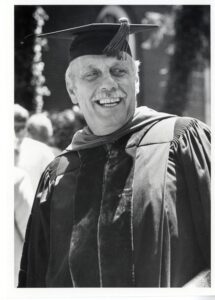
Professor Emeritus of Environmental Science and Biology Michael Bass passed away Oct. 4, 2024. He was a beloved figure at Mary Washington, especially among the countless environmental science majors he inspired to go into the field, and the Class of 1972, which established a scholarship in his honor. Photo courtesy of the Department of Earth and Environmental Sciences.

“I knew that I had made the right choice by coming to a small school with a professor filled with the same wonder and passion for nature that I had,” said May, who has spent decades protecting water quality along the East Coast. “Dr. Bass’ kindness, ability to listen to his students, and desire to share his knowledge was unmatched. I’m forever grateful for the role he played in helping me find a career that I love.”

It often takes generations for tiny saplings to become towering trees, but in just a few years, Dr. Bass grew Mary Washington’s fledging environmental science program to one that has cultivated careers for countless alumni over the decades. After he passed away on Oct. 4, 2024, tributes poured in, from graduates who were influenced by their former professor to enter professions relating to his field, and those who appreciated the support that he and wife Heather gave the Mary Washington community.

“Dr. Bass helped plant some seeds for me to work in environmental conservation,” said Jessie Thomas-Blate ’03, a director of river restoration at American Rivers, a national nonprofit organization where she specializes in dam removal. “I wish I had the chance to talk with him about some of the big issues we’re facing today.”

Sidney Griffith Keith ’85 remembered how Dr. Bass supported her work with the Virginia Department of Environmental Quality and her decision to become an educator. “He told me that teaching was the best way to truly share a love of science, inquiry, and an understanding of our world and universe,” she said.

Dr. Bass held several research positions before joining the Mary Washington faculty, where he became the first chair of the Department of Environmental Science and Geology (now Earth and Environmental Sciences). He earned a Ph.D. from Virginia Polytechnic Institute and State University in 1976 and spent more than 45 years in the classroom at Mary Washington before retiring in 2018.

Throughout his career, Dr. Bass partnered with nearby localities on projects to monitor water quality, stream bank erosion, and the impact of construction on bodies of water like Massaponax Creek and Ni River. He also helped design retention ponds for the Central Park development in Fredericksburg. Students often contributed to his field work, which enabled them to present their findings at regional and national conferences.

Kathryn Collison Ray ’72, who was a student in the first biology course Dr. Bass taught at Mary Washington, recalled how as a young professor, he was assigned the role of class sponsor for first-year students. “He accepted the challenge and went above and beyond,” she said. “The Class of 1972 loves him for it, and he and his lovely wife, Heather, attended all of our class reunions.”

In celebration of their 50th reunion in 2022, she and her fellow graduates honored the professor with the Class of 1972 Dr. Michael Bass Scholarship, which was awarded for the first time to junior Grace Hannah Buck, an environmental geology and historic preservation major who plans to pursue a career in architectural preservation.

“Receiving this award was like someone telling me they saw my hard work and my potential and wanted to partner with me so I could achieve my educational goals here at UMW,” she said. “I’m so grateful to Dr. Bass and the donors who have made this scholarship possible for me and future students.”

UMW’s Department of Earth and Environmental Sciences will celebrate Dr. Bass’ life and career at Mary Washington with an open-house memorial in the Cedric Rucker University Center’s Chandler Ballroom on Saturday, Feb. 1 from 2-4 p.m. The event is free and open to all current and former members of the UMW community and the public.

For more information about the Class of 1972 Dr. Michael Bass Scholarship or other giving opportunities, please contact the Office of University Advancement at advance@umw.edu or 540-654-1024.

-Article by Assistant Director of Advancement Communications Jill Graziano Laiacona ’04
UMW’s Celebration of Giving Generates Global Connections

University of Mary Washington senior Hayley Madden had an unforgettable experience while visiting England’s National Gallery on a faculty-led trip. An art history major, she presented her own research to her professor and classmates on French painter Élisabeth Vigée Le Brun’s “Self Portrait with a Straw Hat.”

“I’m so grateful to everyone who believed in my potential,” Hayley said. The recipient of the Emil R. Schnellock Scholarship and other awards, she’s now applying to graduate art history programs in London. “You’ve made my Mary Washington education possible while helping to nurture my dream from a simple sketch into a vibrant masterpiece.”

Hayley shared her story – including how she explored museums in nine countries while spending a semester in France and now helps her fellow students plan their own excursions as a Center for International Education peer advisor – at the Celebration of Giving on Nov. 21. Held in the Cedric Rucker University Center’s Chandler Ballroom, this year’s event honored 200-plus donors who listened as students and administrators thanked them for supporting the University’s renowned study abroad program and the international students who live and learn at UMW.

“These pillars of the Mary Washington experience cultivate global perspectives and foster meaningful cross-cultural connections, yet can also be costly for our students,” Vice President for Advancement and Alumni Engagement Katie Turcotte said. “Your gifts help strengthen UMW’s reputation as a hub for international education and student success.”

She thanked supporters for prioritizing UMW in their philanthropic giving during the past fiscal year, with $14.5 million in gifts and pledges raised from 5,146 donors. She also shared 2024 highlights, including the Beyond the Classroom Endowment, which supports student experiential learning like study abroad, surpassing its $1 million goal this fall.

“We’re grateful not only for your investment, but also your example to our students,” UMW President Troy Paino said. Noting UMW’s distinction as top producer of Peace Corps volunteers and Fulbright scholars, he said that curiosity, open-mindedness, humility, and a desire to learn about other cultures are critically important in today’s world. “These are traits that we hope to develop in young people so they can be successful and make a difference.”

Junior Aloysious Kabonge, a mathematics and statistics major and data science minor from Uganda, spoke about how the Thomas Howard and Elizabeth Merchent Tardy Scholarship and other awards have helped him earn a broad liberal arts education while embracing campus life.

At UMW, he serves as a Student Alumni Ambassador, resident assistant, and orientation leader. He participated in an alternative service break and joined the African Student Union, which has helped him connect with other international students.

“Your kindness, generosity, and support have changed my life profoundly,” he told his donors. “I’m here today, pursuing my dreams, because of you. You’ve given me opportunities that I could have only imagined, and for that, I’m deeply grateful.”

Senior Sean McGavin shared his own college journey, beginning with hiking all 2,200 miles of the Appalachian Trail during a gap year. At Mary Washington, he discovered a passion for chemistry that was vital to his desire to preserve forests and began working as a wildland firefighter during the summers.

Earning the Sally Brannan Hurt ’92 Study Abroad Scholarship helped Sean go on a faculty-led trip the Galápagos Islands, where he planted trees and learned how other countries address ecological problems. The knowledge he gained abroad influenced his decision to pursue a Ph.D. in chemistry so he can develop environmentally safe retardants to fight fires.

“I didn’t know my purpose before I came to Mary Washington, but I found it here,” said Sean as he thanked Hurt. “Going to the Galápagos … was an opportunity that wouldn’t have been possible for me without Sally’s scholarship and is one that I’ll never forget.”

Senior Mima Manton, who hails from England, said the James E. Baker Community Orchestra Scholarship and other awards supported her in studying music abroad while performing in many university ensembles, including leading the Pep Band.

“My musical experiences have developed in ways that I could have never imagined,” said Mima, who performed a piece on bassoon with Music Chair and Professor Brooks Kuykendall on piano. “I cannot stress enough that without my scholarships, I wouldn’t be standing in front of you today.”

Learn more about establishing scholarships and how private support makes a difference in the lives of UMW students who receive scholarships, research fellowships, and internship grants.

View photos from the 2024 Celebration of Giving.

– Article by Assistant Director of Advancement Communications Jill Graziano Laiacona ’04
UMW Senior’s Passion for Video Production Takes Focus With Impact Grant

When University of Mary Washington senior Steve McClanahan pitched a proposal last spring that secured a Fund for Mary Washington Impact Grant, it wasn’t his first time appearing before a live audience.

Digital Knowledge Center Director Cartland Berge (left) and UMW senior Steve McClanahan pose for a picture in the Charnoff Production Studio, along with the upgraded technology that was supported by Fund for Mary Washington Impact Grant. A gift from Mikhael Charnoff '95 and Katherine Valentine Charnoff '04 covered the cost of an accessible production desk to house the new broadcast panel. Photo by Sam Cahill.
Digital Knowledge Center Director Cartland Berge (left) and UMW senior Steve McClanahan pose for a picture in the Charnoff Production Studio, along with the upgraded technology that was supported by Fund for Mary Washington Impact Grant. A gift from Mikhael Charnoff ’95 and Katherine Valentine Charnoff ’04 covered the cost of an accessible production desk to house the new broadcast panel. Photo by Sam Cahill.

Steve has spent his college years participating in a weekly comedy show – think Saturday Night Live – where students learn to pitch sketches, write scripts, operate camera equipment, edit video, and produce live-streamed shows as part of a Digital Media Studio course.

“I thought you’d need to go to New York or Hollywood to do something like that,” said Steve, a psychology major and communication and digital studies minor who aspires to teach the latter. “I’ve gained so much professional experience from this.”

His passion for the project persuaded Cartland Berge, Digital Knowledge Center (DKC) director and adjunct instructor, to recruit Steve to share his story during the inaugural Fund for Mary Washington Impact Grant presentations in April. Together, they earned a $4,000 Impact Grant for a new broadcast panel in the Hurley Convergence Center’s (HCC) Charnoff Production Studio.

“This program is funding innovative projects that are benefiting our students,” said Cartland, who teaches the class required to participate in Are We Live?. The updated technology will replace the older version that’s been in place since the HCC opened a decade ago, he said. “We’re giving them the opportunity to work with the industry-standard tools they’ll use if they pursue a career in this field.”

Steve (left) and Cartland pitched a proposal last spring that secured a Fund for Mary Washington Impact Grant that supported much-needed updates for the Charnoff Production Studio in the Hurley Convergence Center. Photo by Karen Pearlman.

Piloted by UMW’s Office of Advancement and Alumni Engagement, the Impact Grant program awarded $25,000 this year in donor-funded grants to projects and initiatives proposed by students, faculty, and staff on behalf of recognized campus organizations. Applications for the 2025 Impact Grants are open through the end of January.

“We’re true believers in a broad liberal arts education,” said Mikhael Charnoff ’95, who made the original 2019 gift with wife Katherine Valentine Charnoff ’04 to name the studio. “In the past, college communications courses included rhetoric and speech, but today’s world requires video and digital media skills. Mary Washington students should have the resources to keep up and make a difference.”

The couple also made a recent gift to help purchase a new production desk to house the broadcast panel, providing increased accessibility for students and faculty.

“The studio used to have screens and other gear sticking out, and it was hurting the process,” Steve said. “Now, everything is streamlined.”

Steve, who graduates this spring, is no longer involved with Are We Live? but continues to produce online series through the UMW University Communications department’s Lively video project. He has already created Balancing Acts, interviewing Mary Washington students and faculty about their busy schedules. He’s producing another series this semester capturing Mary Washington memories and turning them into art.

Fittingly, his favorite memories feature the Are We Live? show, returning for its seventh season in February.

Cartland (left) and Steve try out the new broadcast panel, which allows students and faculty to tap into digital tools they didn't have access to before. Photo by Sam Cahill.
Cartland (left) and Steve try out the new broadcast panel, which allows students and faculty to tap into digital tools they didn’t have access to before. Photo by Sam Cahill.

“I think everyone should take a class like this,” Steve said. “It allows you to have fun and be creative while building your digital skillset. I’m so excited for future students to use this new technology and to see what they do with it.”

The Hurley Convergence Center exhibit – “A Decade of Digital Convergence” – celebrating the building’s 10th anniversary will be on display in the HCC’s Digital Gallery through the end of the year.

UMW’s Fund for Mary Washington Impact Grants program is made possible through donors’ gifts to the Fund for Mary Washington. These gifts are vital to the University’s ability to improve the student experience and support faculty, providing crucial flexibility to respond to emerging challenges and seize opportunities as they arise. When alumni, parents, friends, faculty, and staff give to the Fund for Mary Washington, they are choosing to be part of a community that is committed to giving back and making the world a better place – enabling students to make positive change through programs like the Fund for Mary Washington Impact Grants.

The Office of Advancement and Alumni Engagement is welcoming applications for projects that will take place between May 2025 and May 2026. UMW students, faculty, and staff are encouraged to apply for donor-funded grants ranging from $500 to $5,000 on behalf of recognized campus organizations. Learn more.

– Article written by Assistant Director of Advancement Communications Jill Graziano Laiacona ’04 

UMW’s Great Lives Lecture Series Announces 2025 Lineup, New Director

The 22nd season of the William B. Crawley Great Lives Lecture Series at the University of Mary Washington will kick off Jan. 21, 2025, and run Tuesday and Thursday evenings through March 20.

A selection of fascinating figures will be profiled during this year’s William B. Crawley Great Lives Lecture Series at the University of Mary Washington. The 22nd season of the popular series was announced Tuesday evening at a presentation that welcomed over 160 supporters, donors, and sponsors to UMW’s Jepson Alumni Executive Center.

This year, bestselling biographers will shine a light on senator and civil rights leader John Lewis, broadcast journalist Barbara Walters, controversial baseball great Pete Rose, Crazy Horse and Sitting Bull, and over a dozen other notable individuals from history and culture.

Yet, of all the larger-than-life personalities highlighted on Nov. 12, the one that drew the most applause was series founder and Distinguished Professor Emeritus of History William Crawley, who announced his retirement. His co-director, Scott Harris ’83, executive director of UMW Museums, will oversee the series – the latest installment of which starts on Jan. 21, 2025 – moving forward.

UMW students and the local community have been the beneficiaries of Great Lives, Dr. Crawley said, which began as an academic course offered by UMW’s Department of History and American Studies with a free public lecture series.

John and Mary Lou Chappell, the founding donor and his wife, who are long-time supporters of Great Lives, enabled the series to attract biographers who provide insight into the lives of the world’s most prominent personalities. In 2016, the program was renamed the William B. Crawley Great Lives Lecture Series. Numerous local organizations, corporations, and individuals throughout the Fredericksburg area sponsor lectures and support the series.

“No one has benefited perhaps more than I have, because [Great Lives] has allowed me to interact with some of the most interesting and preeminent writers and scholars of our time … including a number of Pulitzer Prize winners,” Dr. Crawley said. Under his leadership, the series has featured more than 325 subjects in the last two decades, with many of the lectures later broadcast on C-SPAN.

“Bill, you are a wonderful representative and role model for our students today,” UMW President Troy Paino said. “You’ve started something that brings together the community, and I want to thank you for making the Great Lives series possible.”

Scott, who was one of Dr. Crawley’s students and has served as Great Lives co-director for the past year, earned a bachelor’s degree with honors in history and historic preservation from Mary Washington and a master’s in history and museum administration from the College of William and Mary.

He has been employed at UMW since 2011 and has served in his current role since 2018, overseeing Gari Melchers Home and Studio at Belmont, the James Monroe Museum, and the Papers of James Monroe. He is past president of the Virginia Association of Museums and is an editorial advisor and frequent contributor to the White House Historical Association’s journal, White House History Quarterly.

“Bill, you have been my teacher, my colleague, and my friend,” Scott said. “It’s been a privilege to work with you over this past year on Great Lives, and I’m more honored than I can say to succeed you.”

This year’s series kicks off Jan. 21, with New York Times bestselling author and reporter Liza Mundy’s The Sisterhood: The Secret Women of the CIA, spotlighting the female operatives who have gathered intelligence for the United States over the last century. Mundy is also the author of Code Girls: The Untold Story of the American Women Code Breakers of World War II, which she brought to UMW in 2018.

Distinguished Professor Emeritus of Physics Bulent Atalay will delve into the world’s most brilliant brains in a lecture titled “Da Vinci, Shakespeare, Newton, Beethoven, and Einstein.” A scientist, writer, and artist, Atalay is the author of Beyond Genius: A Journey Through the Characteristics and Legacies of Transformative Minds.

Other lectures will chronicle the lives of Twilight Zone creator and host Rod Serling, enslaved African American poet Phillis Wheatley, First Lady Pat Nixon, starlet and inventor Hedy Lamarr, and even Jay Gatsby, referring to both F. Scott Fitzgerald’s famous novel and its titular character. Audiences will also have the chance to learn about the unlikely friendship between astronaut John Glenn and baseball legend Ted Williams, Confederate general James Longstreet, President James A. Garfield, and Captain James Cook.

Great Lives lectures are held Tuesdays and Thursdays through the end of March 2025. All are open to the public free of charge and begin at 7:30 p.m. in George Washington Hall’s Dodd Auditorium.

Dates, topics, speakers, and sponsors for 2025 are:

Jan. 21
Women of the CIA, presented by Liza Mundy. The Chancellor’s Village Lecture.

Jan. 23
Pete Rose, presented by Keith O’Brien. The John and Linda Coker Lecture.

Jan. 28
Rod Serling, presented by Anne Serling. The Russell Mait and Barbara Stone Mait ’79 Lecture.

Jan. 30
Barbara Walters, presented by Susan Page. The Gemini 3 Group Lecture.

Feb. 4
John Glenn and Ted Williams, presented by Adam Lazarus. The Davenport & Company Lecture.

Feb. 6
Crazy Horse and Sitting Bull, presented by Mark Lee Gardner. The Synergy Periodontics and Implants Lecture.

Feb. 13
John Lewis, presented by Raymond Arsenault. The Irene and Curry Roberts Lecture.

Feb. 18
Captain James Cook, presented by Hampton Sides. The Stephen Gaske and Patricia Powers Gaske ’75 Lecture.

Feb. 20
James A. Garfield, presented by C.W. Goodyear. The Yuh Prosthodontics Lecture.

Feb. 25
Da Vinci, Shakespeare, Newton, Beethoven, and Einstein, presented by Bulent Atalay. The Coldwell Banker Elite Lecture.

Feb. 27
Phillis Wheatly: America’s First Black Poet, presented by David Waldstreicher. The UMW Museums Lecture.

March 11
James Longstreet, presented by Elizabeth Varon. The Walter Jervis Sheffield Lecture.

March 13
Pat Nixon, presented by Heath Hardage Lee. The Jubilation by Silver Companies Lecture.

March 18
Hedy Lamarr, presented by Stephen Michael Shearer. The Roxanne M. Kaufman Lecture.

March 20
Jay Gatsby, presented by Bob Batchelor. The UMW Dining Lecture.

For information on Great Lives sponsorships, please contact Jeremy Vaughn ’08 in the Office of University Advancement at jvaughn@umw.edu or 540-654-2063. 

– Article written by Assistant Director of Advancement Communications Jill Graziano Laiacona ’04